NewsNation interviewed me for their podcast to talk about the state of the games industry and about building a new engine at Immens.
The full episode is on YouTube:

NewsNation interviewed me for their podcast to talk about the state of the games industry and about building a new engine at Immens.
The full episode is on YouTube:
Gamesindustry.biz sat down with us, the three founders of Immens, to talk about why we are building a new game engine, and why now.
Read the full interview: Three Epic veterans are building an AI-powered game engine to break the industry's doom cycle
I am also at Gamescom next week, ping me if you want to meet!
Announcing that I have joined the founders team at Immens.dev as Chief Product Officer, with as goal to build the game engine of the future.
The week in games just did an interview with me as well - Epic Games' former Unreal Engine evangelist is making his own engine
Here is my thinking about where things are heading in the industry, and why we think creating a new engine is the right path:
First off, for the sake of the industry, we need competition and alternatives in the engine space. The entire industry is largely dependent on just two companies and their decisions. The one and only true alternative that has emerged in the last 15(!) or so years and that has gotten widespread traction has been Godot.
Over the last 10-15 years the standardization of engines and workflows has streamlined things, which in turn has helped provide the foundation that led to the growth of the industry and which in turn created opportunities for many, but the industry today is facing a whole new set of challenges due to saturation, player consolidation, formula driven generic experiences, team/budget sizes vs revenue, and so forth. As we have all seen the industry finds itself on shaky ground as it is trying to figure out where to go from here. While the standardization has helped the industry in the last decade, going forward I think we now need innovation to overcome the challenges the industry is seeing, rather than standardization.
The mission is to create an engine that can take a fresh approach to things, can operate at scale, for games of any size, and including all that entails to do that well. To operate an engine means to not just consider the technical aspect, but also the business side of it, the wider ecosystem, support, and so forth. That is the ambition.
I love Unreal Engine, as my track record shows, and Unity has powered many great games and teams too, but after decades of continuous development both engines are carrying ever more baggage and ever more legacy code, features, tools, workflows and so forth that they need to either maintain or support, or that they are constrained by. This is natural, and hard to avoid, but it is nonetheless complexity that spills over to the dev working on their game.
If I take a step back and reflect on things I think things have become very convoluted for both. Case in point, after 27 years of Unreal Engine, my genuine honest assessment for how much of Unreal Engine I now know is about 4% only...
So this makes me wonder, where is this heading? What would we do if we were to start fresh? What is possible in terms of things like performance or iteration times, extendibility, ease of use, and so forth? Especially if you also consider point 3 and 4 ->
Again I love the way we have all gotten used to of making games, I owe my career and everything I ever made to it, but here too I think we need to take a step back, ensure we don't get engrained in past perspectives, and really contemplate on where things are heading or what is possible in the future.
The way we have generally been working for decades now is that as we download a piece of software, that is typically developed by a set of people at a company somewhere, that works in a very established & set kind of ways (shortcuts, features, workflows) as designed by the developers of that software, and often saving proprietary formats that require said software. To work with it, you must learn and adapt to the way that program was made to be used. If you want something changed, you can request that change and if you are lucky a few months/years later it gets added in, or if you have the source code you could do it yourself but you will still need to go and deal with that change/recompile/maintaining your fork. This is true for almost all software, including game engines and most game dev tools.
But I don't think that model will survive the coming years. I think we are going to see a lot more bespoke tooling and software in the future. Software should adjust to you, not you to it.
I am an artist and designer and so like many of us I am often constrained by being able to execute on what it is I want to do because it relies on the tooling, or engine, or implementation of things. But we have now entered a world where we can create tools, workflows, prototype things, or connect things together, and it is going to dramatically speed up and open up things. You can create the exact tools with the exact UX, with the exact shortcuts, features and behaviour that you need for how you want to work and for your particular project. And if you can do that, so can others. It means we will go to a world where there is a lot more solutions and tools out there that people share or collaborate on, or can integrate with in turn.
The last time I felt like this was in 2013 with Blueprint, where suddenly it opened up a huge world of being able to create essentially entire games single-handedly, as many have done over the last 13 years. We are at such inflection point here again, and it is going to change how we work and what we expect out of software.
There is a ton more to say on this topic but for now, what it means for an engine: A rock solid and very efficient core engine that is highly flexible and extendible so that it can be used exactly as you require it to work. Easy to add or interchange any parts to it, seamlessly able to interact with a wide range of libraries/tools/DCCs/services/APIs, using text based or standard languages or formats wherever possible.
What we are seeing today is a lot of agentic coding, but I think that is just the tip of the iceberg for where this can go. The possibilities are huge, and it requires an engine that is built with this in mind from day one. It requires agents to be able to fully comprehend the game and all the millions of pieces it is made up of, and how it all fits together, so that it can reason about its changes in the context of the entire game.
AI can be used in a positive and responsible way, to empower developers and allow them to iterate and experiment faster, which in turn will help creativity. We don't want prompt to game or other such low value use, but we want to find the valuable uses for it, that are compatible with how developers work. Iteration speed, tooling, prototyping, and so forth. That will help us forward as an industry, and I believe there the possibilities are near endless. It feels in a way like a return to the creative frontier of the 90s and 2000s, where workflows weren't set in stone and everything felt open for experimentation, which I find very exciting.
After 27 years of Unreal Engine, and 12 years at Epic Games and Unreal Engine I have decided to move on. Last week was my last week at Epic.
This has been an awesome ride that has been truly life changing in so many ways. I didn't have an easy childhood or youth and things weren't going anywhere, but all of that changed entirely when I discovered Unreal Engine. Unreal Engine 1/2/3 put me on a very interesting trajectory for life, which in turn had a profound impact on myself as a person, my personal growth, and opportunities that opened up.
And then Unreal Engine 4 and 5 did it all over again. Having gone through the whole of the Unreal Engine 4 era, and then the Unreal Engine 5 era while at Epic it gave me a tremendously wide and deep view across the industry and the world. Dozens of countries visited, hundreds of studios visited, hundreds of talks presented, tens of thousands of people met, and millions of developers supported every year.
I have seen so much over the years, but what will stick with me the most is the community and everyone out there making cool things, and all the energy and passion that comes with doing so. That is what it is all about at the end of the day, to create, have fun doing it, and to help each other.
But all of that being said, I feel like this era has come to a close, and it is time to move forward. The industry is in a very interesting place. The games industry has always been an industry where change is relentless and inevitable, but it feels like we are reaching a pivotal point now and a potent mix of things.
As much as I love the old way of working, I think it would be strategic to come to terms with where this is heading, and to work out how to adapt and excel at solving a few challenges or opportunities that we face.
Lets see where we end up :)
I have made another environment, similar to the one I posted a few weeks ago. Just like the first one this was made in Unreal Engine 5, and just for fun and for the sake of making something pretty.
The theme remains the same. An earthly landscape, alien skies, a clear foreground/background delination, and megalithic architecture present. The idea with both landscapes was to mimmick a style commonly seen in 18-19th century paintings.


Just like the first landscape, this one too took 4 days to put together, and was made using almost only free assets I found on Fab.
I put together a quick and rough image that showed how the environment progressed, and how long each step took.

A lot of the work that went into this is hard to capture on some work in progress screens though. There is a lot of fine tuning that went into this, and lots of small manual tweaks and creative solutions to get total control over the colors.
There are quite a few subtle fog planes (planes that color what is behind them) in the environment, as well as blur planes (slight softening of what is behind the plane). To get it all to work well at every time of day takes quite a lot of tweaking too. Several of the materials read the atmosphere color or the rotation of the directional light, and adjust their brightness, colors or other such things based on where the sun is at and what color the atmosphere is.
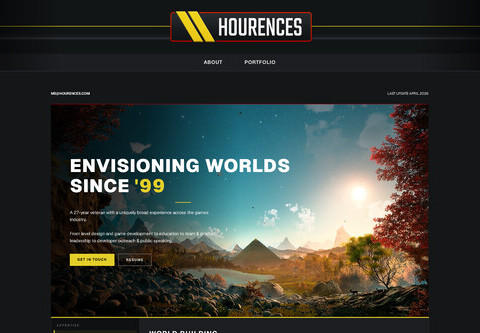
It's only been ten years since the previous update... but hello again!
I have completely remade both my Hourences.com, and my portfolio sites, and merged them both into a singular site. Pure HTML, to avoid any kind of framework or other external dependencies in the years ahead, and with responsive design that works decent on mobile too.
As part of setting up the new site I have collected as much of my work from the last ten years as I could still find back. Unfortunately some content, in particular tutorials and tutorial videos, and many of my talks, seem to have gone offline, but nonetheless I did managed to find quite a bit still.

Key New Pages:
A while back I also did an Unreal Engine 5 environment just for fun. 4 days of work (was a bit rusty - been a while). Megascan rocks, vegetation from Fab. Other than that self made, including the whole cloud/night time sky/eclipse etc. set up.


I remember how in 2005 I began writing the first edition of my book The Hows and Whys of Level Design. I had a lengthy daily commute, and one of those fairly early gen PDAs with a touch screen. I typed out the bulk of the entire book out on that PDA over a period of several months, using nothing but the little touch pen. I typed so much, that the plastic touch screen began eroding away where the most common letters were.
Over the course of the years I released 2 books, and 7 big Unreal Engine 3 and 4 video tutorial projects. They did awesome. Your response and support over the years has been super great. The books were never a financial success, something that is hard to accomplish with a book on a niche subject, but the uptake and the impact they’ve had over the years has been significant. Without any marketing or sales, and only selling the content via my own website the books sold more copies than the target sales numbers many game dev book publishers appear to aim for.
Likewise for the videos. Many bought those, and the response has been wonderful. Thanks so much for the help and support, and to allow me to carry on creating things!
As a Christmas gift to the community I am hereby releasing all of my books and all of my videos for free! You can find all the content on the various pages on the site.
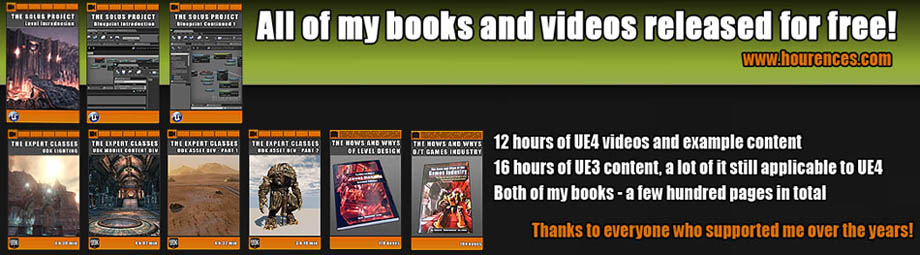
Some of the content is beginning to age. The UE4 videos were done using 4.0 so there are some minor interface differences, but otherwise they still hold up perfectly fine.
The UDK videos might appear very old, but since they go so in-depth on technical topics a lot of it is surprisingly relevant still for UE4. Many of the deeper technical things in UE3 are still identical in UE4, apart from interface changes.
For the books I am planning major updates in the year(s) ahead. I will start off with the games industry book because it is easier to update (fewer example images needed), but I hope to eventually move over to the level design one too. All updates will be released for free and openly. If time allows I hope to transition it out of the PDF form and onto a pure HTML form too later on.
Thanks again to all who have previously bought this content and supported me!
–
2016 has been as crazy as every year. On behalf of Epic I visited a few dozen cities and countries evangelizing the Unreal Engine, and met thousands of studios, developers, and enthusiasts alike.
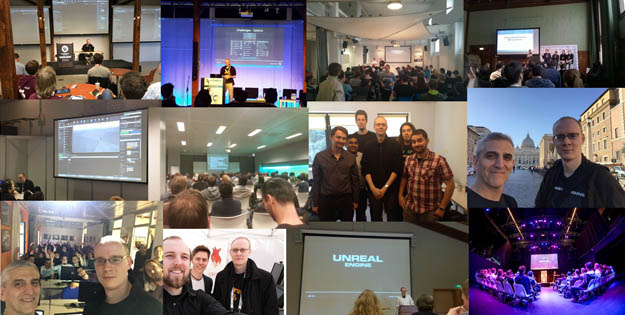
My work at the education Futuregames in Stockholm also carried on as usual, hitting another ~80% success rate on people being hired into the industry on the day of graduation.
After exactly 3 years of work, my game The Solus Project also finally launched. In June for PC, in July for Xbox One. I could write a book about what I experienced and learned from the whole process, but in short it has gone great. For a team of only a few people, operating on a near zero budget, the game shipped a very solid 150 000 copies in the first six months of its release.
Alongside with my previous two games The Ball and Unmechanical, my small company has now shipped well over half a million copies. With having done indie releases in 2010, 2012, and 2016 I experienced 3 distinct stages of the industry. When we launched The Ball in 2010 there weren’t any Youtubers or Twitch streamers for example. Yet in these 3 different markets, we managed to perform consistently. All 3 games were done with an absolute minimum budget, with small teams, and in unorthodox ways.
Entering the 18th year since I began using UnrealEd 1, it has been a crazy ride that has enabled me to do so much that I never expected to be able to do.
Here is onto an interesting 2017. Although given the state of affairs I do hope that doesn’t include WW3.
Another year has passed. As always due to time pressure I am rather bad at updating my site, but here goes for a year overview.
This was my 16th year of Unreal and the games industry:
I traveled. A lot. Mostly in my role of Evangelist for the Unreal Engine. I’ve met thousands of people over the past year, and it has been great seeing what everyone is working on!

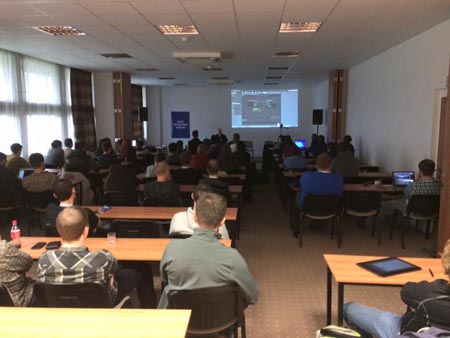

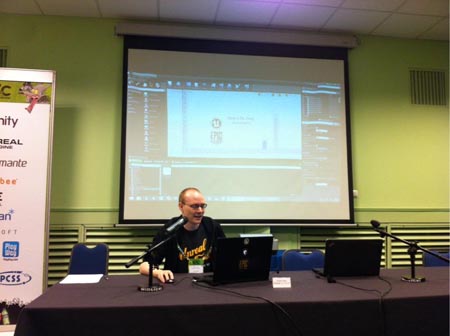
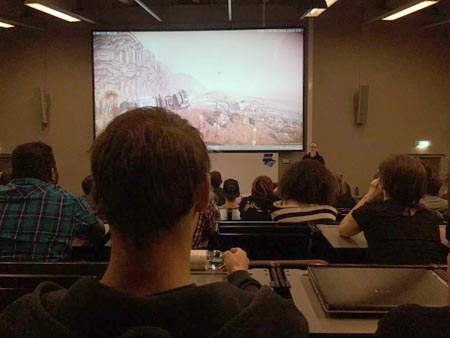
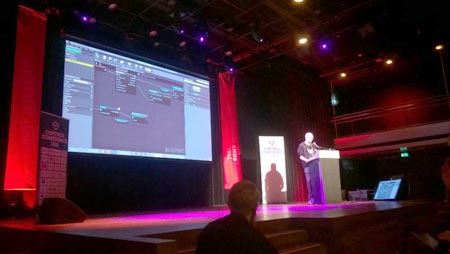
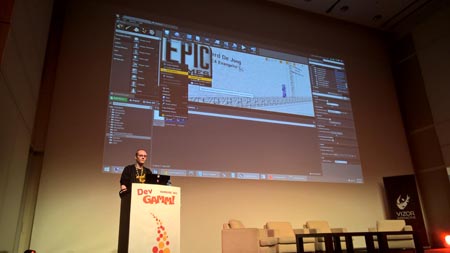
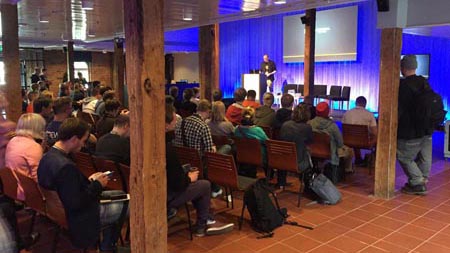
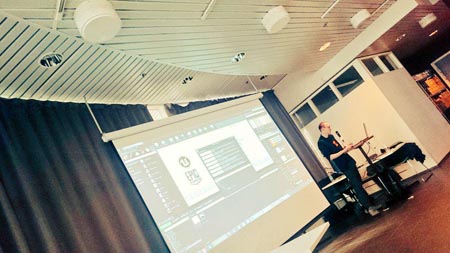
I will continue with my traveling schedule all the way through 2016! If you work for a studio or are studying in Northern Europe and want to do anything with Unreal, let me know!
The Solus Project, in production since July 2013, had its big kick off at E3 in June. Highlights:


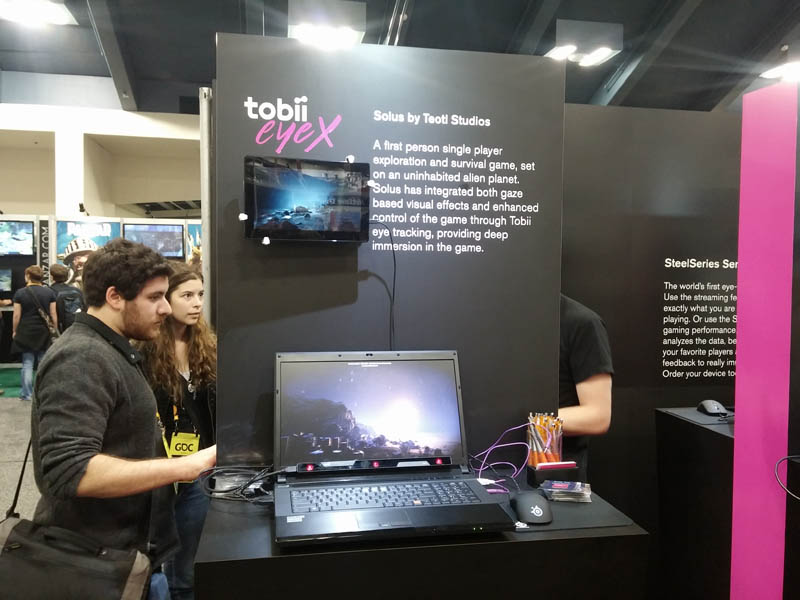
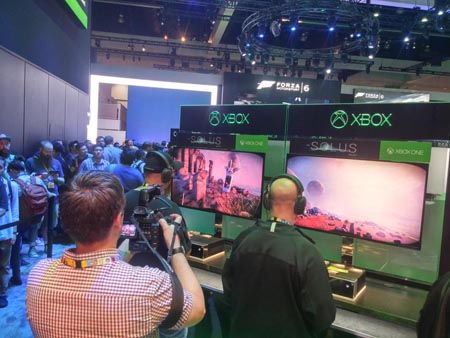
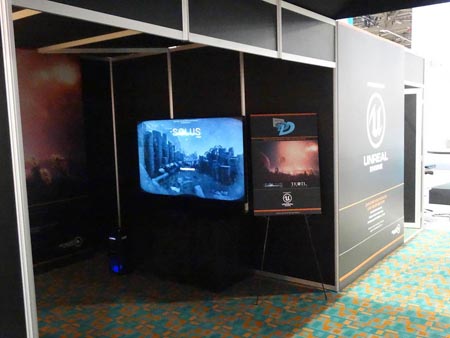
Trailer:
A first release is scheduled around late January, early February 2016.
Continuing involvement with Future Games in Sweden. Accomplishments:
The Solus Project has been doing really well. We announced it will be part of the Xbox Preview program and Steam Early Access in early 2016!

Check out our Steam and Steam Community pages!
To celebrate, I released 1 hour 40 min of new TSP overview videos:
I will be streaming on a nearly daily basis for the next two weeks. Join in and ask questions!
Following up on my post of yesterday, and since “if it is worth doing, it is worth overdoing”, here is part 2.
I went through all the levels I have ever done in the Unreal Engine, and I added up all the actor/mesh/brush/light counts. I still have about 75% of all levels I ever made, and of the remaining 25% I still have a good idea of how complex they were. So I took the accurate numbers of 75% of my levels, and then extrapolated from those to get the estimated numbers for the remaining 25% based. I then added up 30% to the total to take into account all test levels, levels that were never released, done with others, and all work involved tweaking/polishing/redoing parts of levels.
The result is this – This is what 15 years of continuously using Unreal leads to.
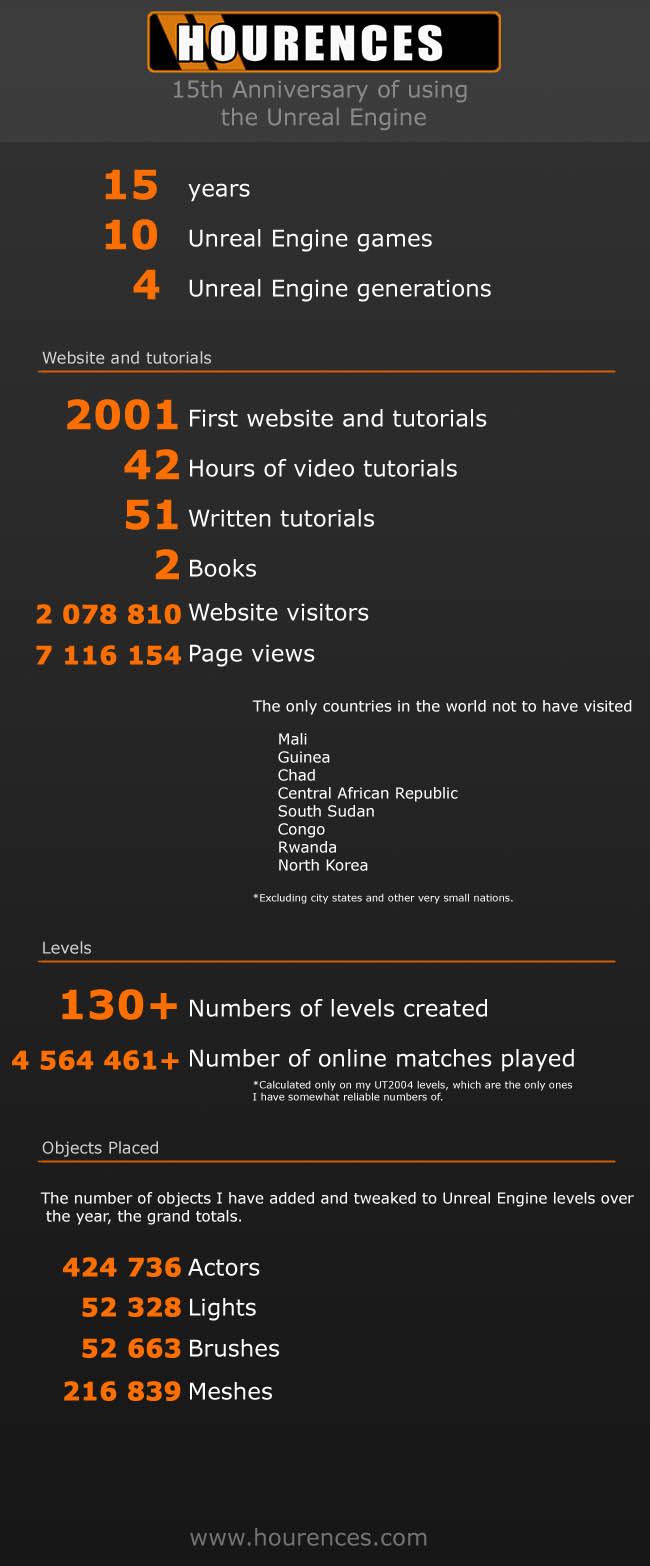
2014 was my 15th anniversary of what I do, and was also my most intense year of the past 15 years. When I started doing this 15 years ago I had no idea it would lead to all of this. My future back then was bleak, then Unreal and levels happened. One and half decade later this is where I am at.
During 2014 I:
What follows over the next few days (this is post one) is an overview of what I’ve done this year, and what I have done in those 15 years being a game developer.
While I have always been a very fast and dedicated worker, in particular during the last 4 years I feel I have really progressed huge steps forward in terms of time management and organization, and the ability to multi task and very rapidly switch back and forth between a wide range of completely different things. And all of the things I learned in the past couple of years have culminated in 2014.
I feel I have also fully mastered the art of focus. I worked non-stop 24/7 without having felt the feeling that I lost focus even once, or that it became too much and unpleasant to work. I took almost not a single break in the past 365 days (about 12 days all in all, weekends and things like Christmas included), nor did I feel I needed one. I love what I do.
I still work for the education Futuregames in Stockholm. I am responsible for the game design students and large parts of the education as a whole, as well as the internship process.
I visited over 50 game studios during the course of this year for one reason or another. From small indie outfits to some of the world’s largest and most well known studios.
By far my coolest visit was the week I spent in the US at Epic Games HQ. It was an awesome experience to finally meet all those people I had known for years! Thanks again Epic!
I have worked for a number of game studios during the course of the year. Some small contracts, some big.
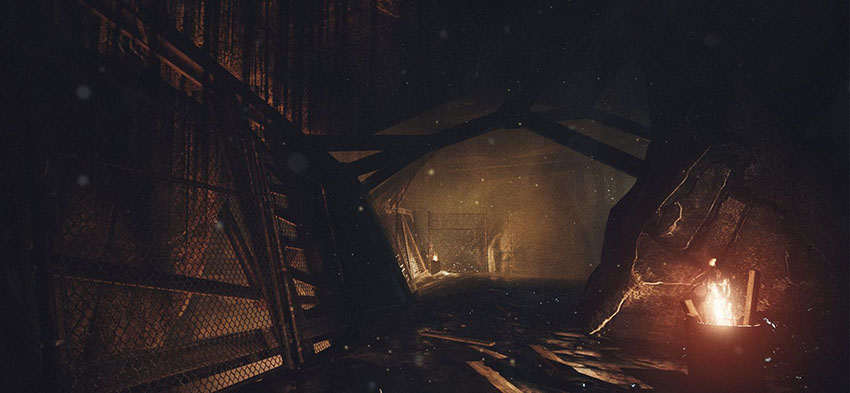
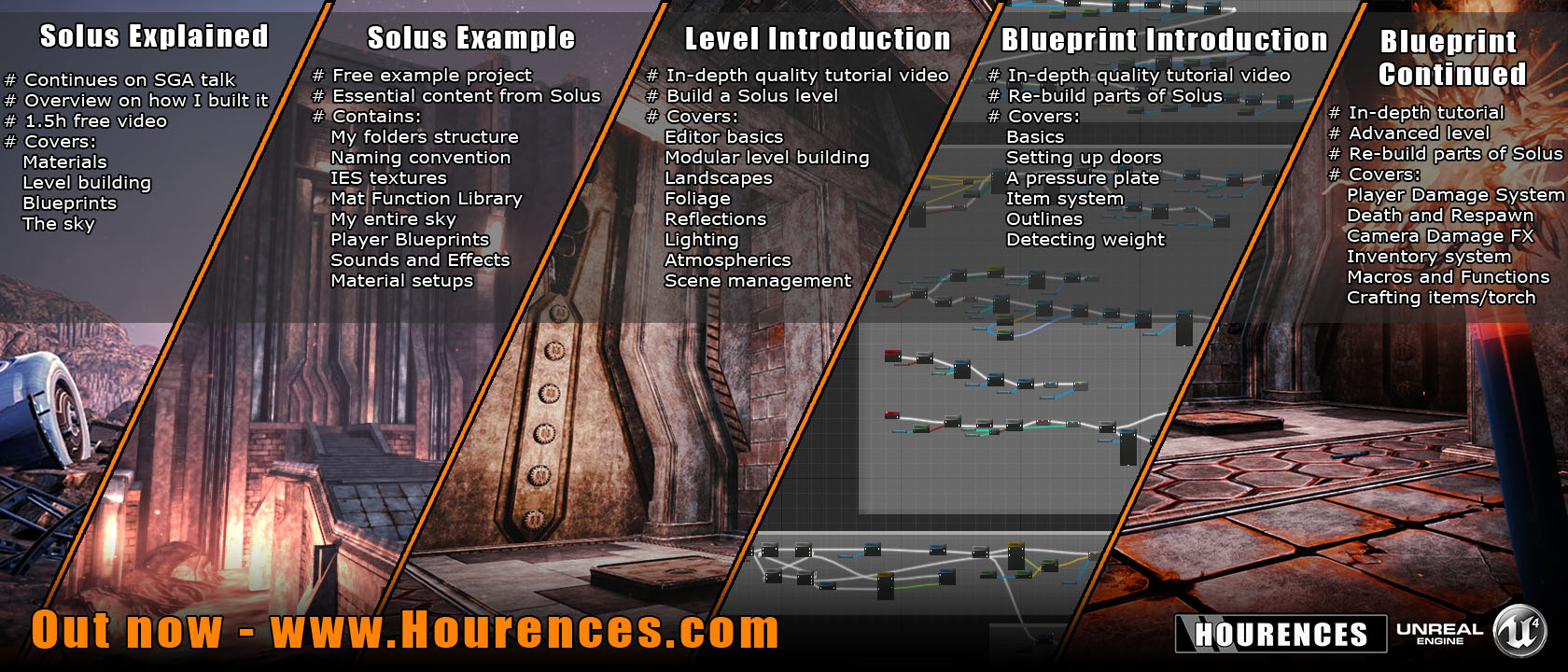
During the course of 2014 I produced 3 large commercial videos based on The Solus Project, along with hours worth of free content. I produced 20+ hours worth of UE4 tutorial content.
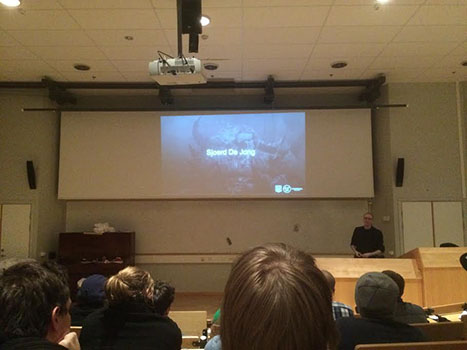
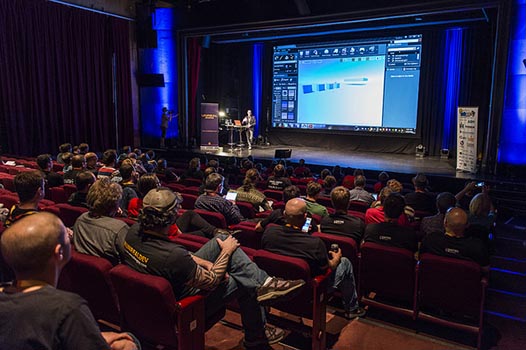
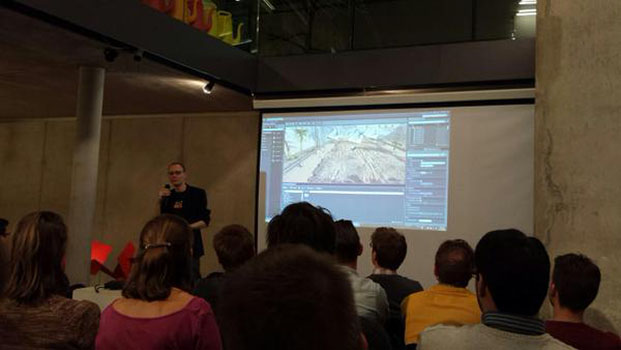
I’ve visited a number of countries, conferences, and educations over the course of 2014 to present Unreal Engine 4.

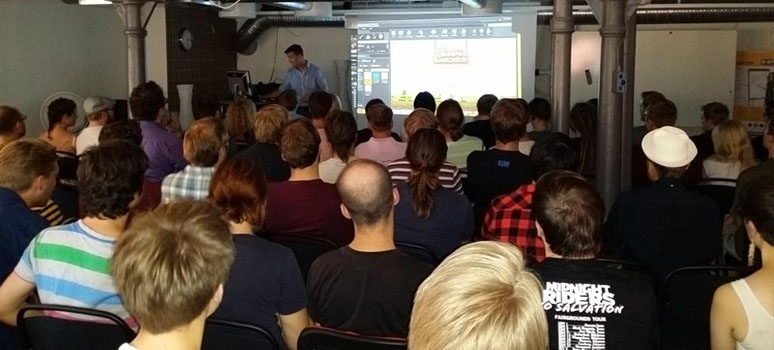
The Solus Project is moving forward at a great pace lately. We now have about 4 hours worth of content pretty far along. Summer 2015 release is the goal.
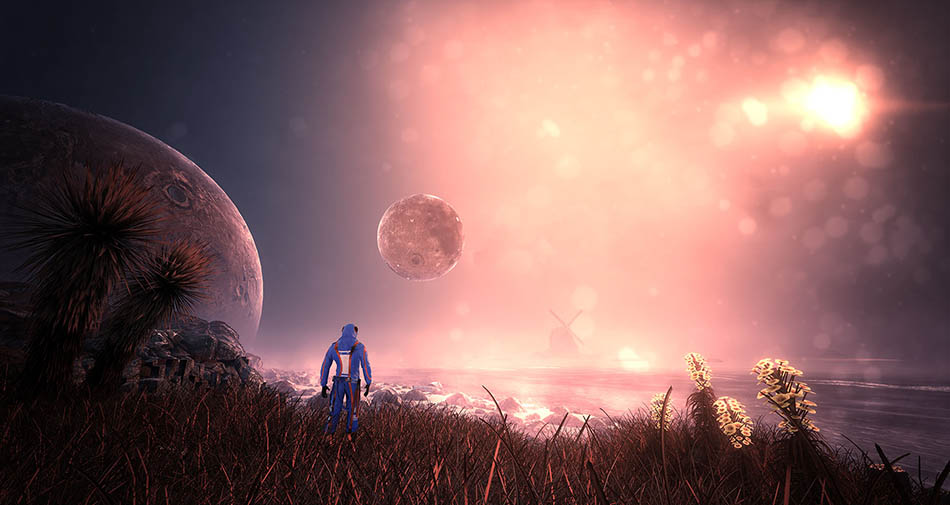
Expansion level and next-gen console release in partnership with Grip Games.
My wife and I were blessed with the birth of Izabella De Jong, born October 17.

On Friday evening, the 12th of December, Epic Games, in cooperation with the IT University of Copenhagen, would like to invite you to Denmark’s first Unreal Evening!
When: December 12. 16.00 until 18.00 – Student presentations, 18.00 until 20.00 – UE4 presentations.
Where: IT University of Copenhagen, Auditorium 1, Rued Langgaards Vej 7, 2300 Copenhagen
Price: Free!

During the last week of November I’ll go on a Dutch and Belgian Unreal Engine tour on behalf of Epic Games, to promote Unreal Engine 4.
Nov 25: Control Conference, Utrecht.
Nov 28: Belgian Unreal Engine Evening, Antwerp.
I am back in Sweden now and had a most awesome time in the US at Epic Games!
Met Tim Sweeney

Epic HQ and Raleigh


Meeting Rama in New York

Part 1 – Project Overview and Visuals
Part 2 – Blueprint update
Rock generation in detail
Epic Games would like to invite you to an Unreal Engine Evening at Futuregames in Stockholm, Thursday August 7th, featuring Zak Parrish.
I returned home last Friday night from a crazy week in the south of Sweden. Here is what happened:
Solus Receives Funding
Solus received 55 000 USD in funding from the Nordic Game Program. This was the second time I applied for Nordic Game Program funding, and the second time it was awarded to us. We previously received 45 000 USD for the development of The Ball in 2010.
The Nordic Game Program is funded by the governments of Scandinavia to further the growth of the entertainment games industry in the nordic region. Since 2006 1277 applications for funding have been filed, of which just 107 have been granted. This year 185 applications for funding were submitted, and just 9 were approved. So I am most grateful to the Nordic Game Program for their continued belief and support in what we do.
Here is my and Wiktor Öhman, artist on Solus, receiving the award on stage.
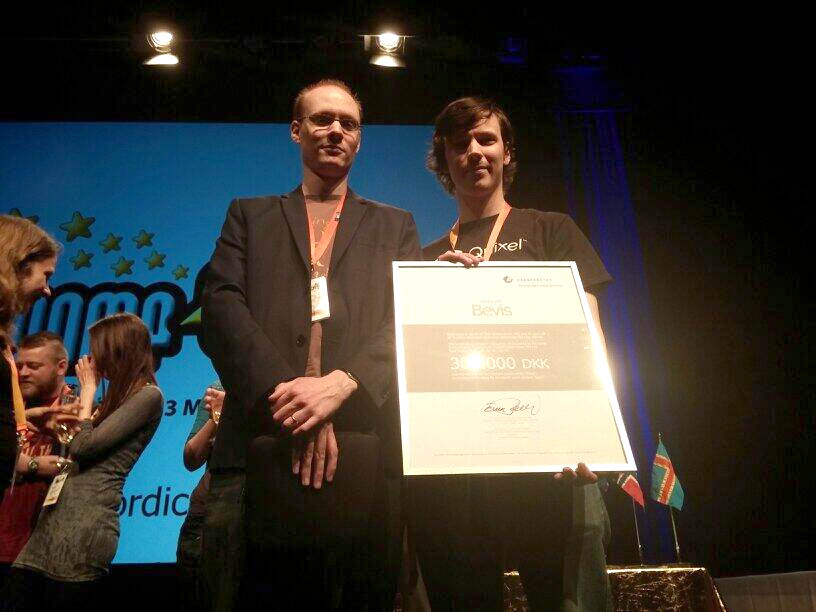
The funding will allow us to get the game to a point in which the first couple of hours are properly playable. Release is still way off. We are looking at some time 2015.
Nordic Game Unreal Engine 4 talk
I did a re-run of my Swedish Game Awards talk at Nordic Games, where I presented Solus and UE4 again on behalf of Epic.
Unreal Developer Meeting
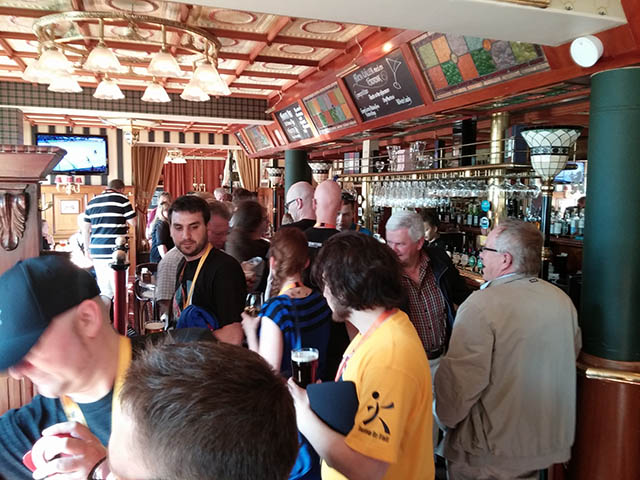
I worked with Epic to set up this event over the past couple of weeks. We rented out a bar near the Nordic Game conference venue, and the whole thing worked out great. We had a great turn out and awesome weather (almost too warm even).
Here are some pictures of the evening.
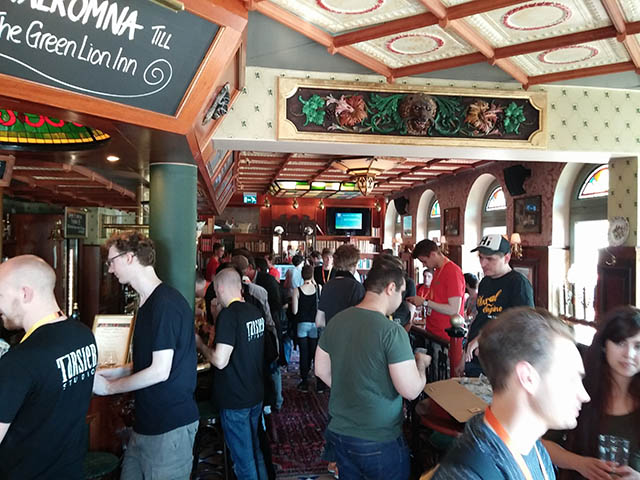
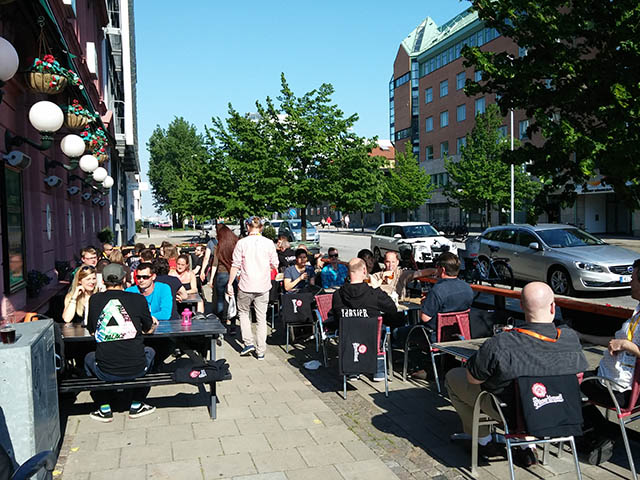
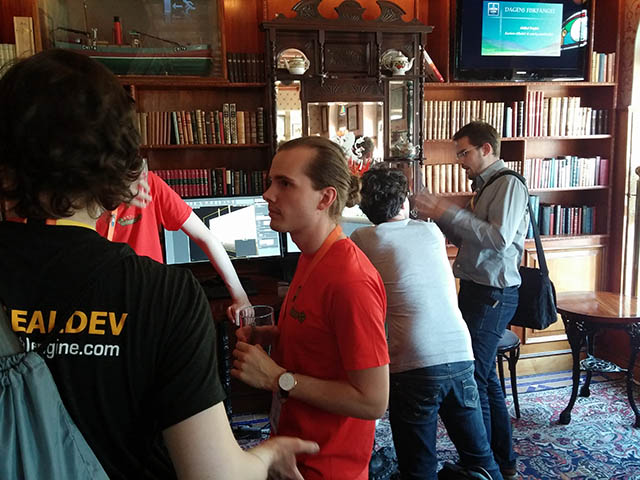
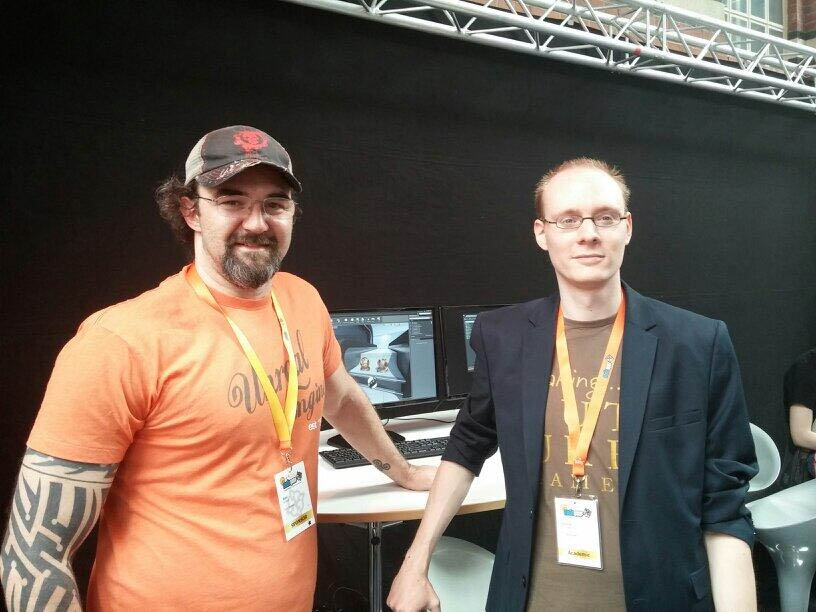
I had a great time meeting up with Epic these last couple of days. And finally had the chance to meet up with Alan Willard, who was one of the level designers on the original Unreal, and has been at Epic ever since.
I am working with Epic Games on setting up the Scandinavian Unreal Engine meet and greet, next week during the Nordic Game Conference. I will also be speaking at the Nordic Game Conference, about Unreal Engine 4 and how the engine aids the speedy development of Solus. And of course I will be at the meet and greet myself as well.
The event is free and open to all. Feel more than free to join in!
Epic Games will host a casual get together on May 22nd at the Green Lion, Malmö, Sweden (close to the central station, and the Nordic Game conference venue) from 4.00 PM CET – 7.00 PM CET.
We are inviting any interested developers to hang out with us and our Scandinavian friends, enjoy some food and drink, and check out Unreal Engine 4.
Attending from Epic will be Mark Rein, vice president; Mike Gamble, European territory manager; Andy Hess, Evangelist; Alan Willard, senior technical artist; and Alan Noon, developer relations technical artist.
In addition, the evening has been organized by our good friend and Unreal Engine guru Sjoerd De Jong, so there will be plenty of opportunities to discuss your projects and challenges with the team.
When: Thursday May 22nd, 2014, from 4.00 PM CET – 7.00 PM CET
Where: The Green Lion bar at Skeppsbron 9, Malmo, Sweden (close to the central station, and the Nordic Game conference venue).
The event is free and open to people of all levels of experience. Free drinks will be available to all developers. A Nordic Game Conference pass is not required to join in on the fun!
The response to my The Solus Project has been awesome. Thanks so much for everyone's kind words and the feedback I got!
Thanks a lot to Epic also for the great support given. My videos are mirrored on the official UnrealEngine Youtube channel, several retweets, and on the official Facebook page. Thanks! Awesome community support!
As for future videos. I do indeed plan to record more. A Blueprint Continued 2, along with a Blueprint for Artist video are on my list. And I will probably re-record the UDK Asset videos in a while as well. So far nothing has yet been recorded though. I am going to wait at least a week more before deciding or starting on anything.
Feedback:
“Bought all 3 of them and just finished watching the 2nd one(bp intro). Absolutely blown away by quality and quantity of information contained in the tutorials and I would wholeheartedly recommend them to everyone looking to get up to speed quickly with UE4.”
SpirosMakris
“Finished watching @Hourences @UnrealEngine Blueprint tutorials. Really great stuff! I'm highly recommend this!
Andrej Sumenkov
“@Hourences UE4 video's are AMAZING if you are looking for some great tutorials to learn @UnrealEngine - find them at http://www.hourences.com”
John Wise
“Purchased @Hourences @UnrealEngine Blueprint tutorials. They're REALLY good, soon done with the intro, learning a lot! 10/10 would recommend”
Daniel K.K
“I finished the tutorial series today and I'm still trying to pick up the pieces from where my mind was blown. As always, great job Hourences (and to the rest of the contributors)! ”
Zooch
If anyone builds stuff with the videos, feel free to mail me a picture or video! I might retweet/post it!
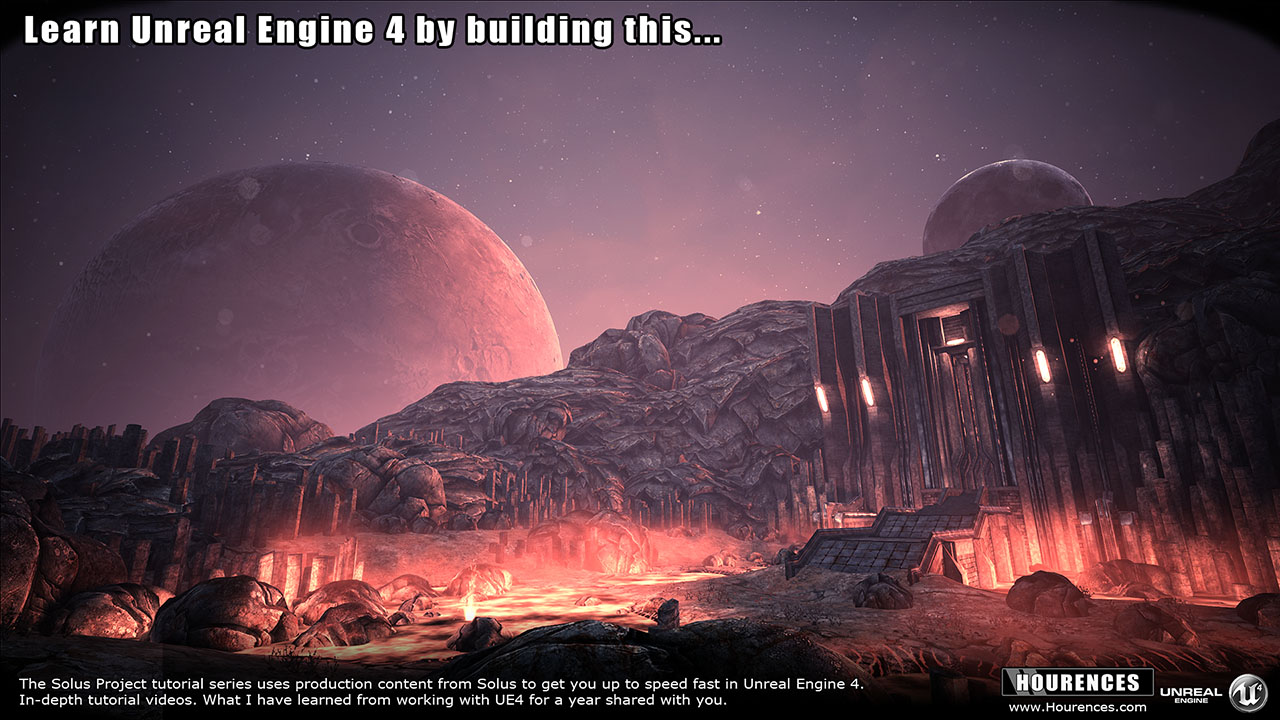
Here is a lot of UE4 stuff all at once!
I stripped down Solus to the essentials and wrapped it up in a Solus Example project, which I am releasing for free.
This free project contains:
Download link 1
Download link 2
Following my presentation at the Swedish Game Awards for Epic, two months ago, I have stepped up my UE4 presentations. I went through some UE4 stuff at my home school of Futuregames in central Stockholm for one.
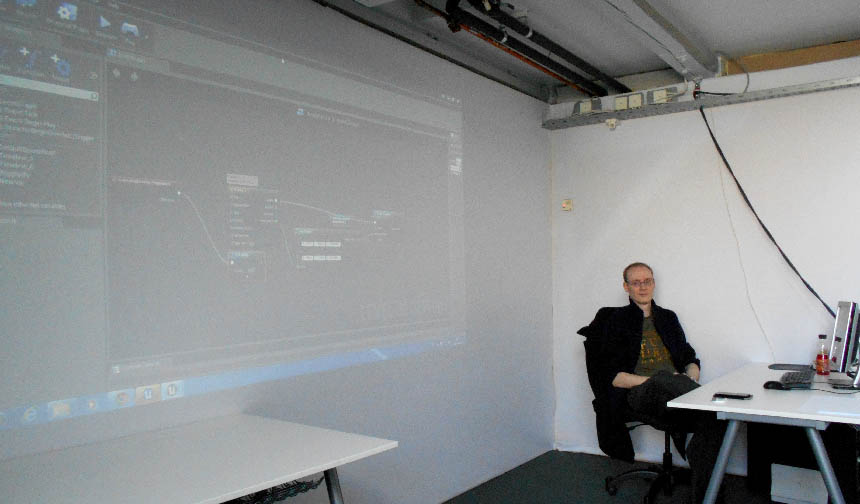
My crazy friend Rama has been working on Solus alongside me for a while now, and he has all kinds of cool stuff out there for those of you who want to get more into C++, or are looking for plugins.
Continuing on the talk I gave at the Swedish Game Awards on my game, I recorded another one and a half hours worth of Solus overview talks. This time with a quality screen capture so you can see exactly what I did in my game.
The video is divided in three parts. All parts are free and available on my Youtube channel.
The Solus Project – Application of Unreal Engine 4 – Part 1
The Solus Project – Application of Unreal Engine 4 – Part 2
The Solus Project – Application of Unreal Engine 4 – Part 3
And (almost) last but not least my in-depth videos, with extensive amounts of Solus content included.
Three videos are being released today.
The Solus Project – Level Building Introduction Preview – See the video page for more info
The Solus Project – Blueprint Introduction Preview – See the video page for more info
The Solus Project – Blueprint Continued 1 Preview – See the video page for more info
The eventual outcome of this video is having a player who can take damage, die, respawn, enable checkpoints, pick up and switch between multiple items, and who can combine a pipe with branches and fire to create a torch.
And also I dropped my UDK videos in price down to 200 SEK, to match the price of the new UE4 videos. Content wise the Lighting and Mobile Dev UDK videos are completely not applicable to UE4, however the two Asset videos are 95% directly applicable to UE4, if you can cope with the difference in interface. Almost all features and tools used in these two videos also exist in UE4, but they may have been placed in another menu/look a bit different.
Epic Games have been so kind to feature a showcase and interview about Solus and my work at the UnrealEngine.com website.
“Blueprint is the game-changer for me. It goes far beyond Kismet in Unreal Engine 3 and is incredibly powerful. I am a designer and artist, and for the first time in my career, Blueprint allows me to make entire prototypes and games without requiring me to touch a line of code. Never have I come across any other visual scripting tool or editor that comes within a thousand miles of the power of Blueprint.”
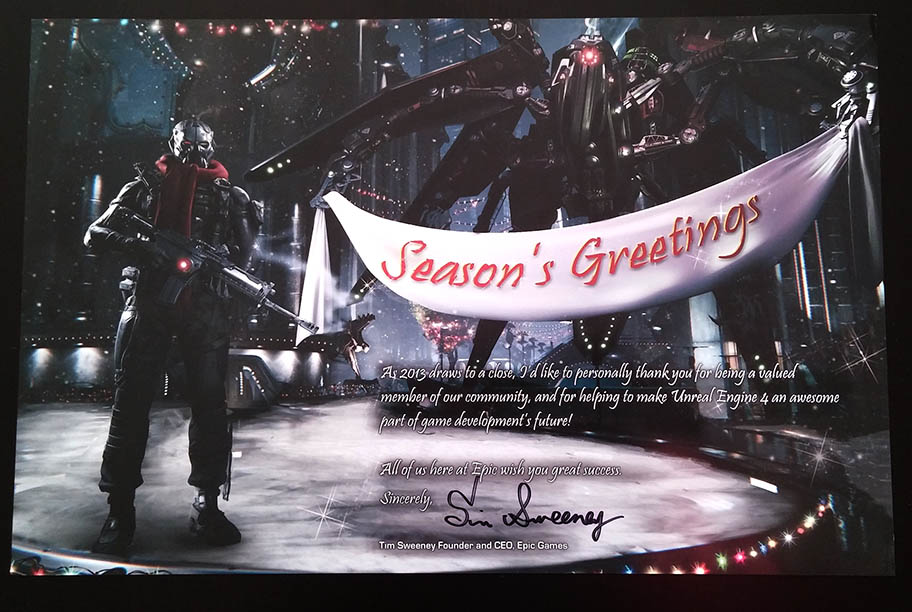
I also received this poster from them:
In other news:
We’ve just released a brand new one hour long The Ball level on Steam, for free!
Named Quizaz, the level is the product of some of the design students class 2012 at the Swedish game development education FutureGames. Hourences set them up with access to the The Ball editor, and guided them into and through development.
Major credits to Anders Bergman, Jacob Antonucci, Björn Jonsson, Christoffer Näll, Claes Fornell, Ludwig Sjöstedt Samuelsson, Tobias Ekholm, Sebastian Contreras - and additional thanks to Peter Cornelius, Stefan Alfredsson.


Steam users can find this level in their Survival menu. Let us know what you think on the Steam forum!
I was interviewed by The Square, a site about the Swedish indie game industry.
I spent the last couple of weeks entirely on visuals, in order to get the video and screenshots ready in time, so after last week’s deadline I now moved on full time to gameplay and scripting. Bianca Savazzi joined me to help out with scripting and programming. We are working next to each other actually, first time I work on one of my own things with someone else working next to me in person.
What we did this week:

Also I received word my Oculus is due to arrive on Wednesday.
Next week we will implement the basic sleeping system, food and water system. Possibly make a start on the item systems, and continued polish of previous things. Our deadline is end of December for a first playable build. Survive the beach. 15 minutes. That is it.
So design wise the major features and elements we figured out are:
Right now everything we got working was done without any programming at all, pure visual scripting, which shows the enormous power of UE4's scripting system.
I uploaded a new version of The Expert Classes Lighting. The assignment level had some left over meshes, and a problem with prefabs (that weren’t suppose to be there anyway). This was fixed.
If anyone wants to get their hands on the new version but finds their previous download links no longer working, shoot me a mail and I will set you up.

I am proud to announce my new game Solus - www.SolusTheGame.com
Solus is a single player exploration and survival game, experienced in first person and developed in Unreal Engine 4. It is set on a mysterious and uninhabited alien planet.
Core Gameplay Values
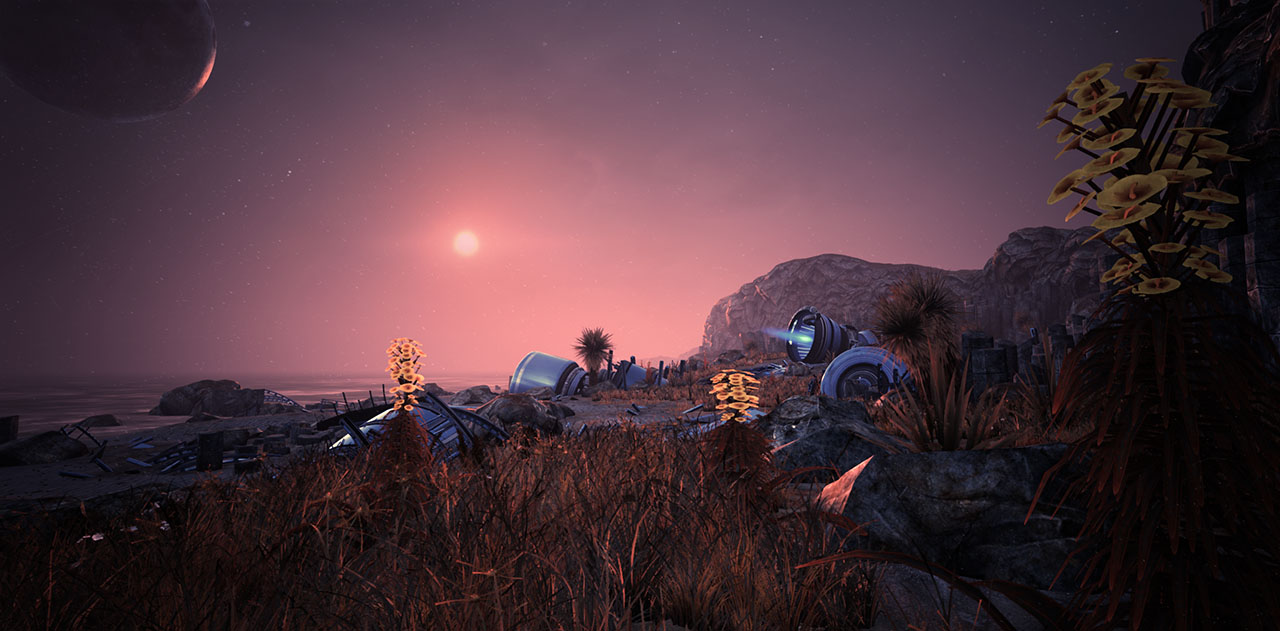
Features and Development
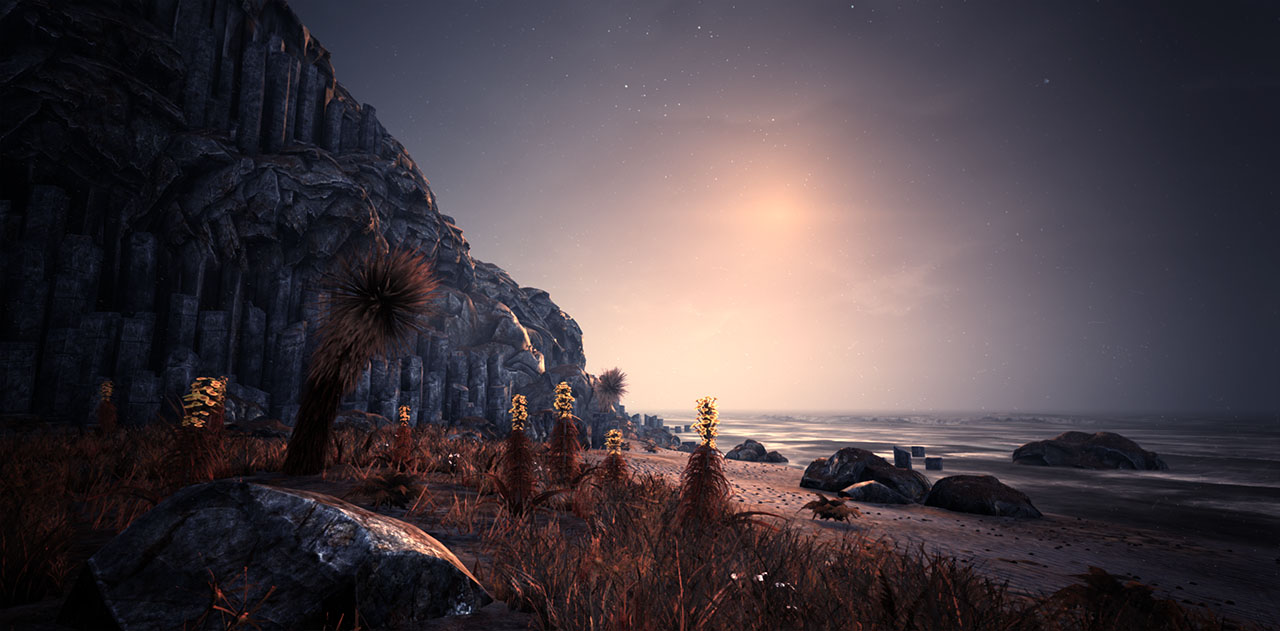
The Planet
Next gen Unreal Engine 4. I have been working with UE4 since last March, and have been working on Solus since July on an off and on basis.
It is meant as the spiritual successor to The Ball. Same universe, different planet. Like with The Ball it is a big new game early on in the Unreal Engine cycle. It is atmosphere driven and level design heavy just like The Ball. And like with The Ball I am being the one man army doing loads of work on this all on my own. It is my vision, concept, and style. The whole sky and weather system is mine, the color pallet and atmosphere, a lot of the models, all of the scripting, many of the particle effects, etc. And I did all of that in just 4 months time, part time.
The idea is to make a living and breathing planet, so you really feel like you are trapped on this beautiful but dangerously active alien planet. I took it far. I got tide, temperature, wind, and so on. They change dependent on the environment. If it is clear skies nights are colder but days are warmer. If there is a lot of wind, nights are colder. You can be hit by lightning and die. If it rains the temperature goes down. Flowers close during the night. The environment actually reflects everything when it begins to rain. And so on.
For me this wasn’t just a challenge to learn the new tools and features, and to get the style right, it was also all about making it not just work and look good, but doing those two things in a way that I can reproduce and extend it further rapidly. On the beach scene, spaceship parts aside, the only things that were actually modeled were the foliage meshes and one single hexagon pillar. Everything else you see is generated through clever tricks. Everything is highly modular. I designed a giant box of legos that I can now give to level designers and have them make whatever they want using the same pieces over and over again. The thing takes less than 1 GB memory while running, while using 4096 and 2048 textures for nearly everything you see.
The game is far from completion, this is just an early sneak peak and teaser. Nothing in the pictures is representative of the final quality.
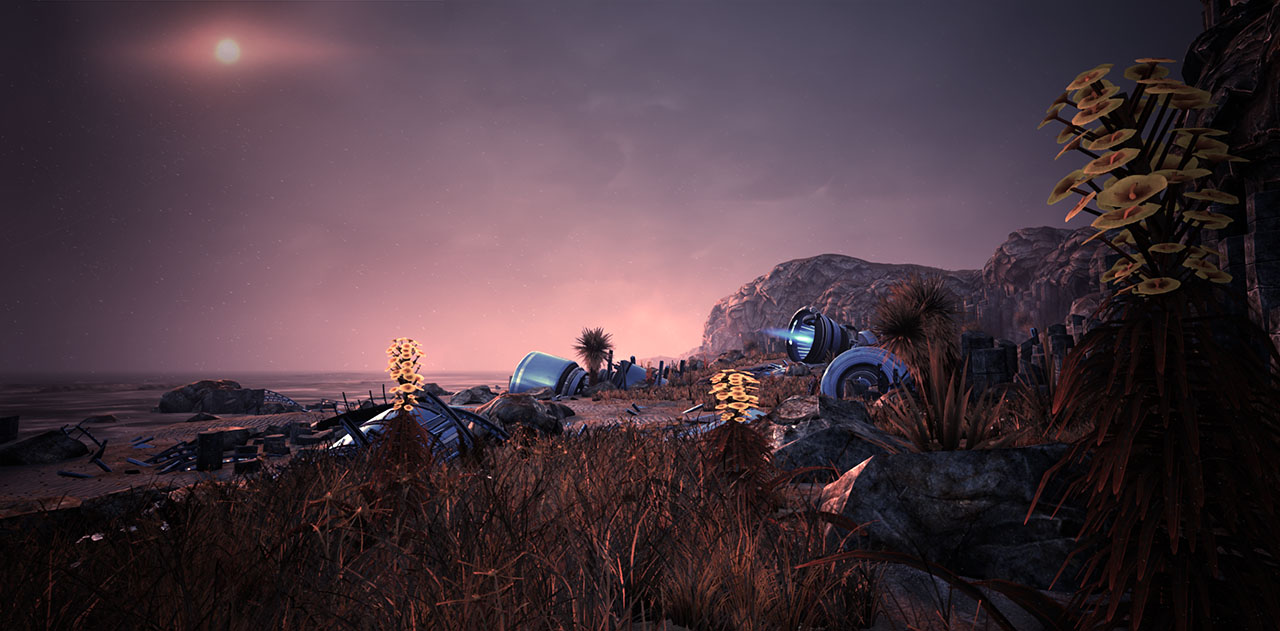
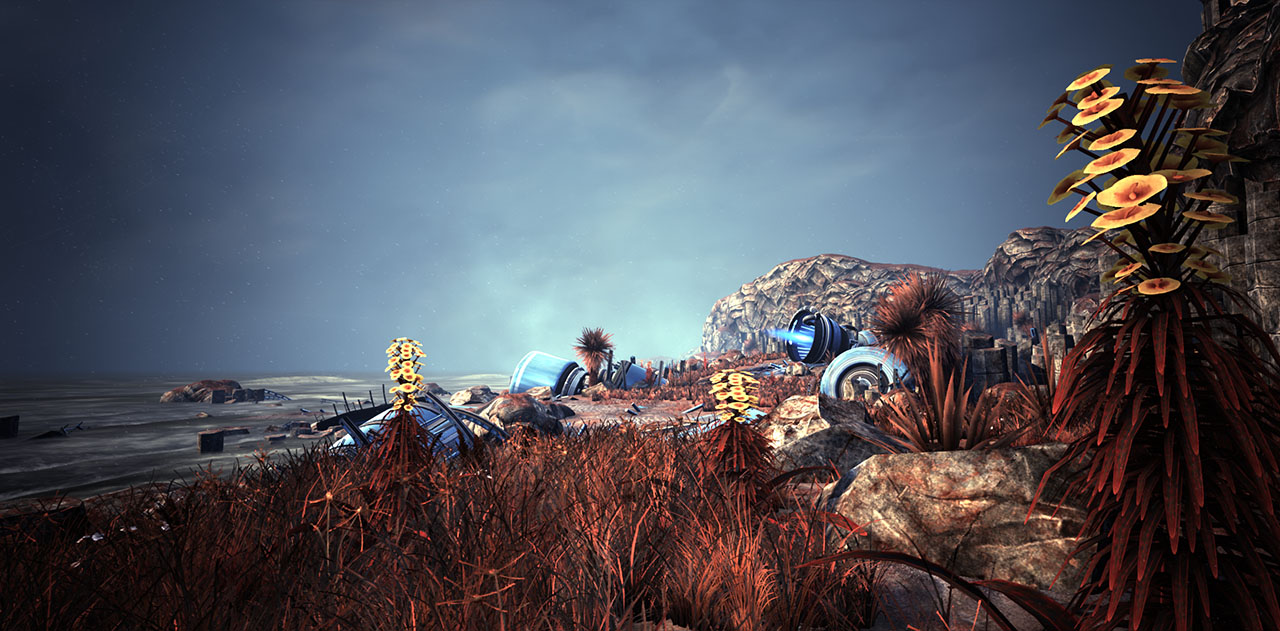
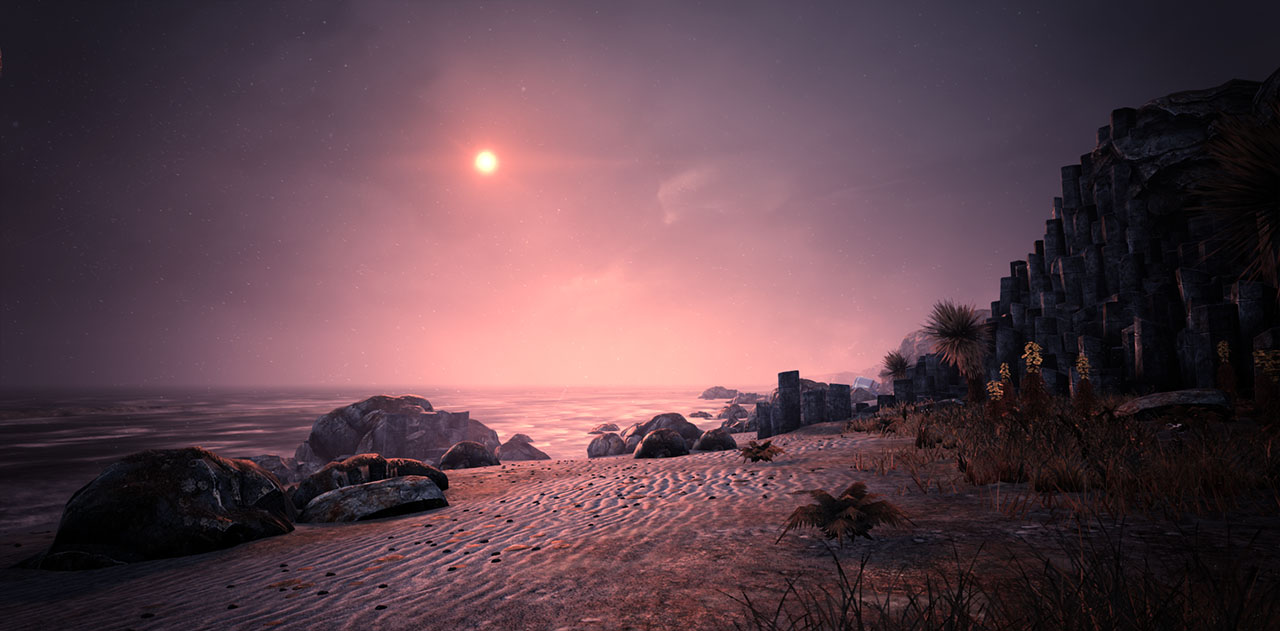
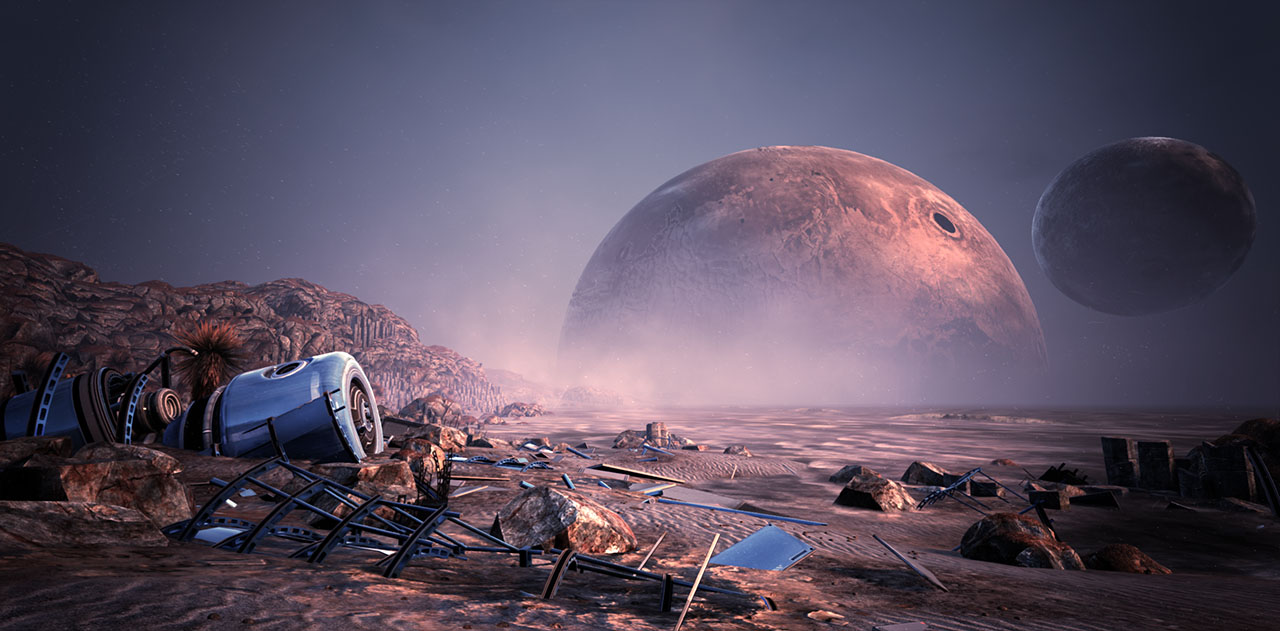
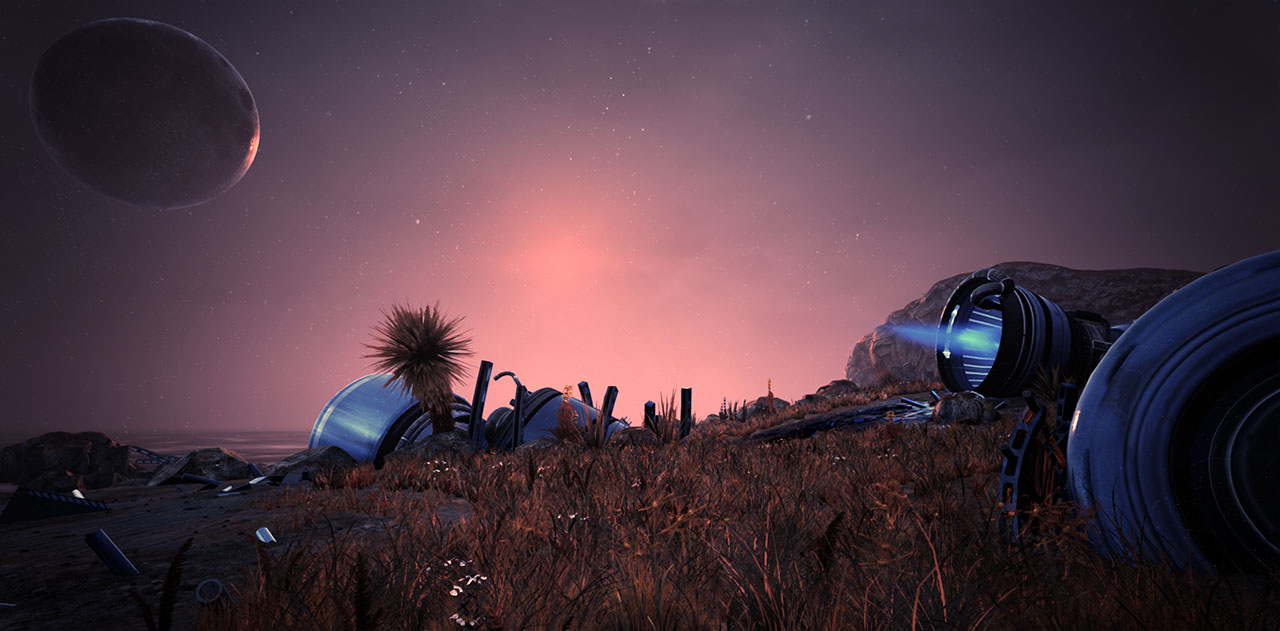
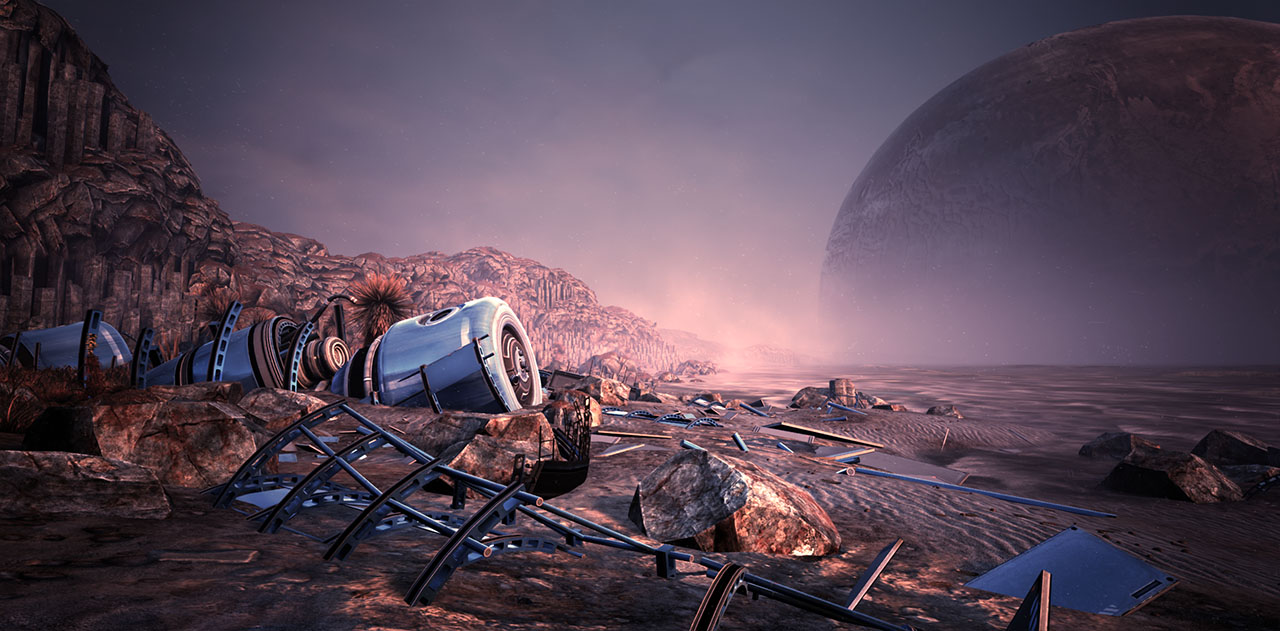
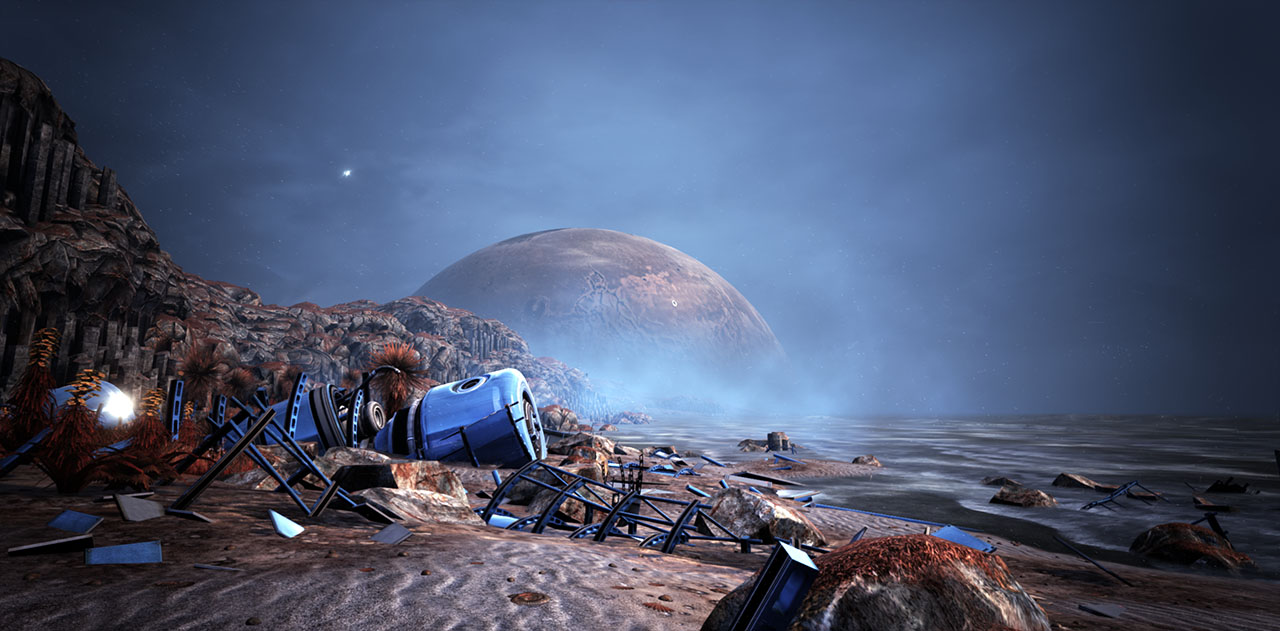
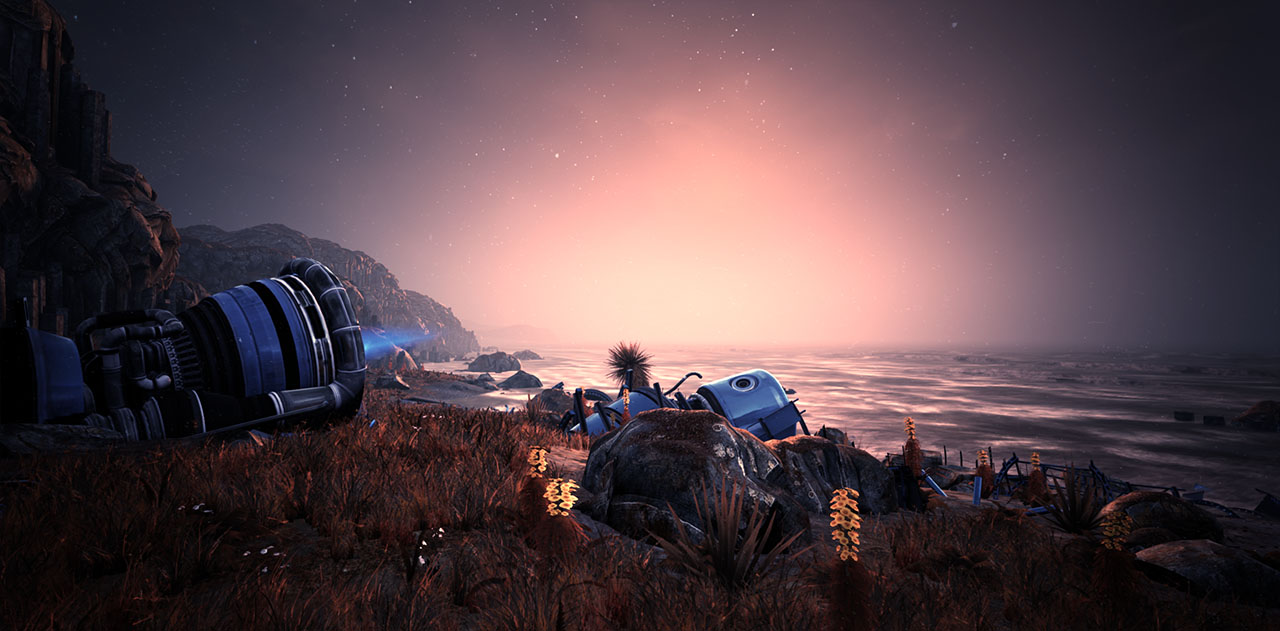
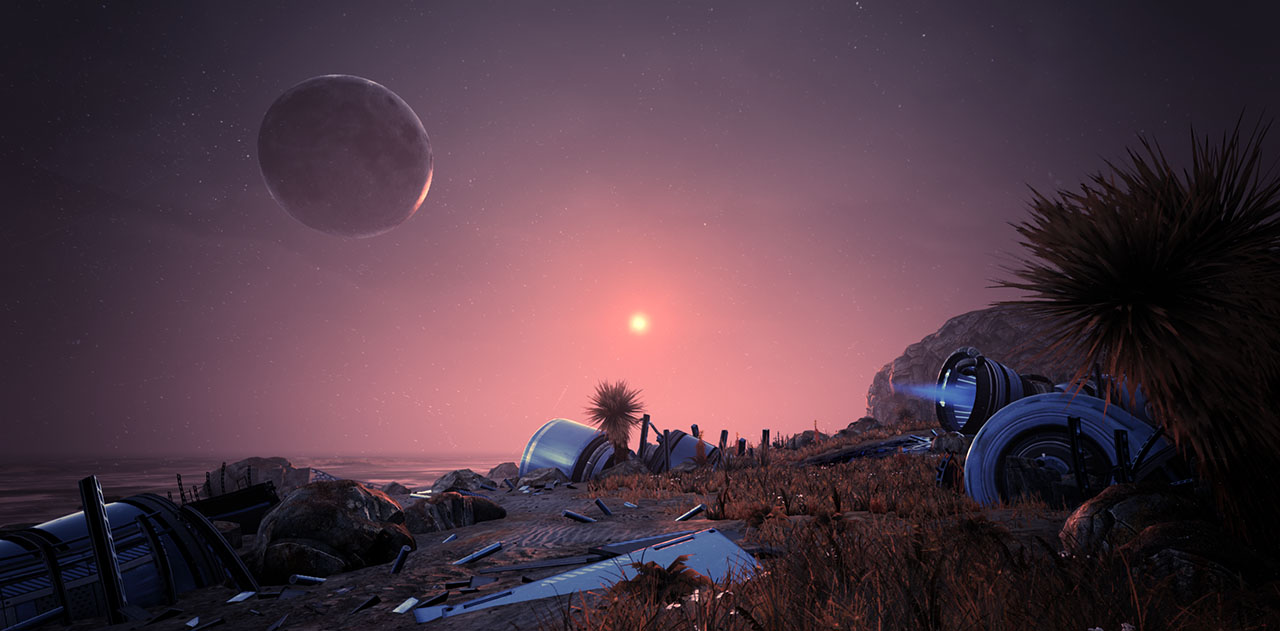
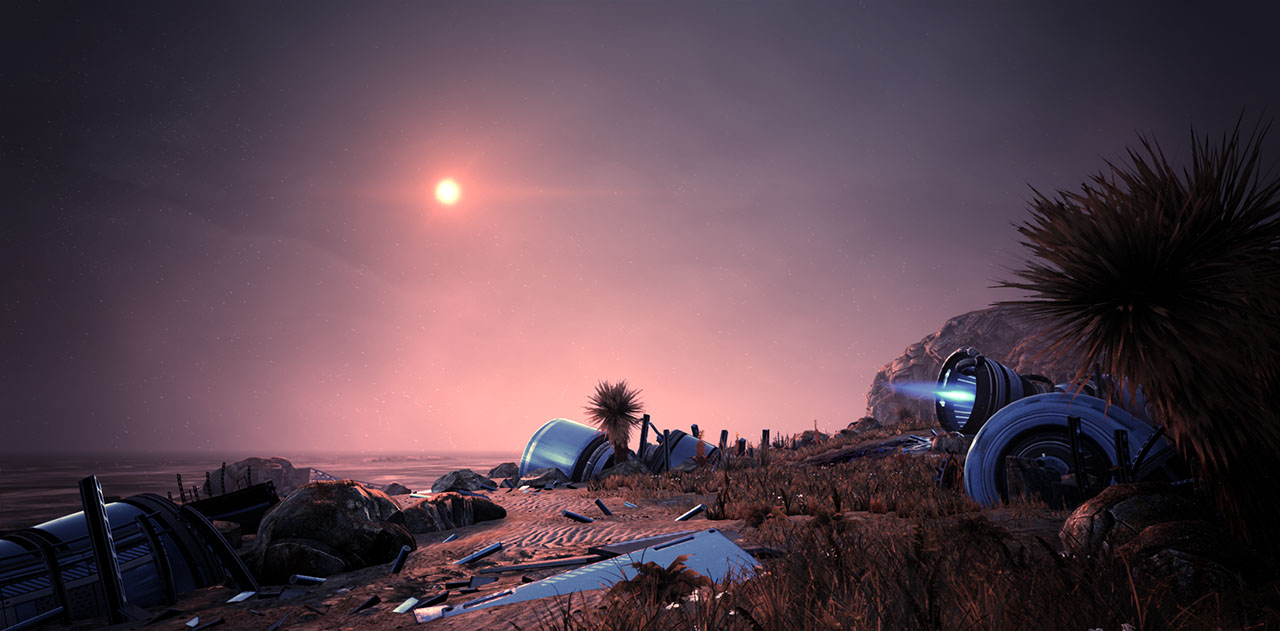
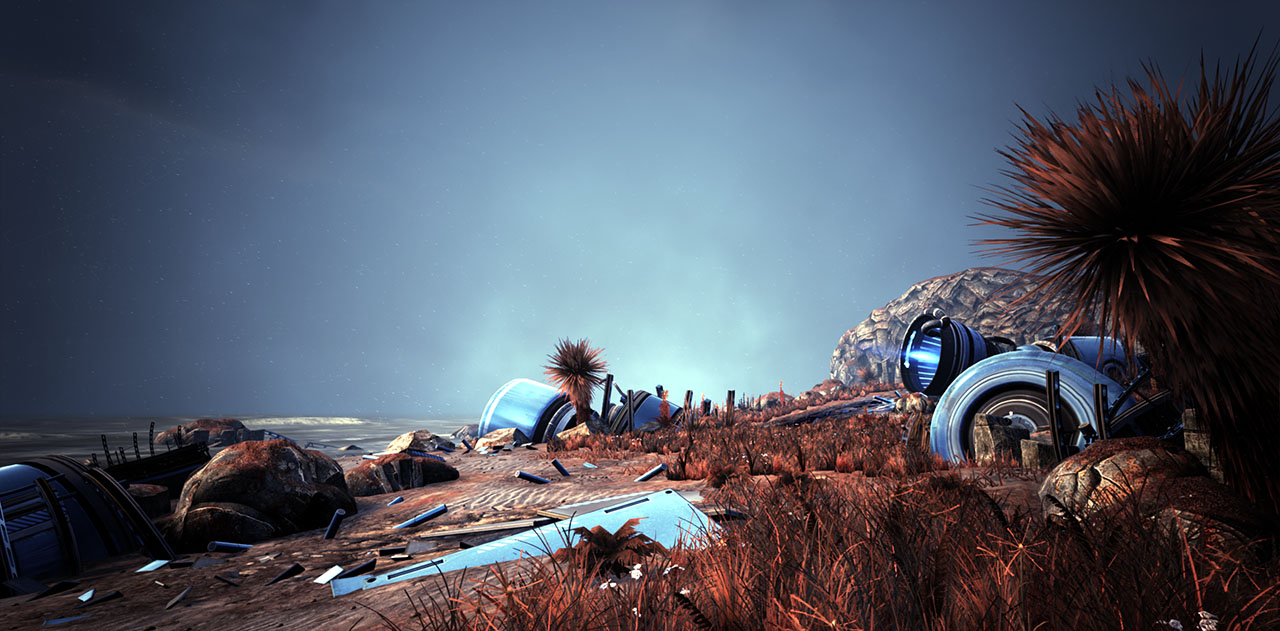
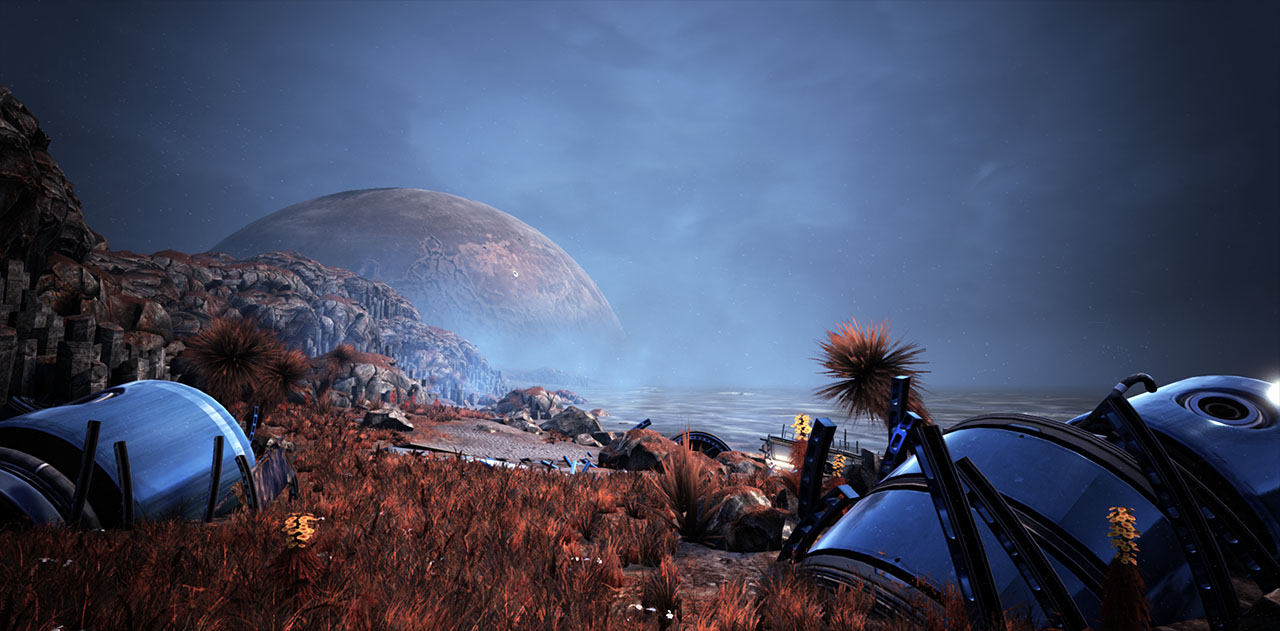
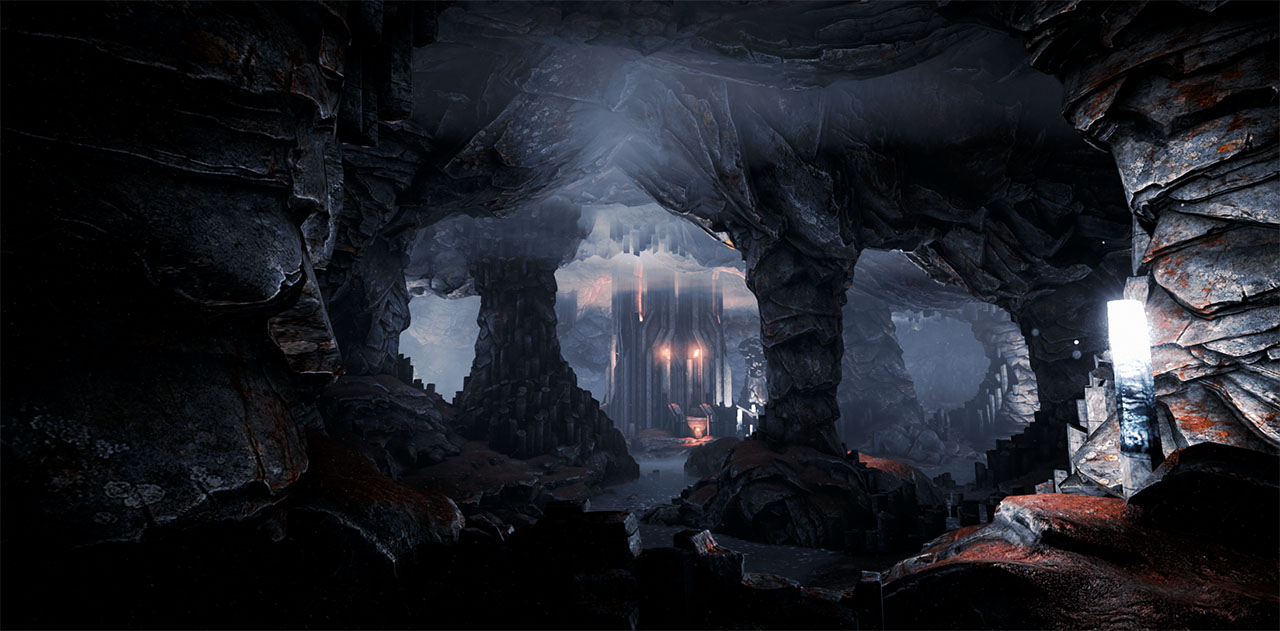
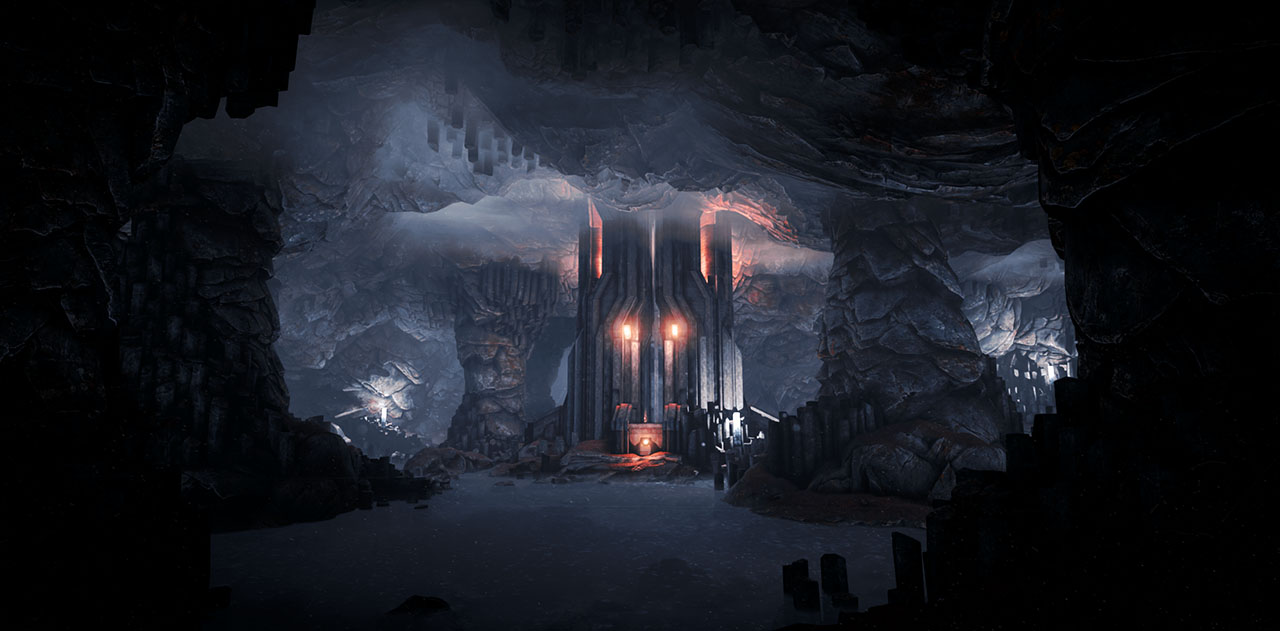
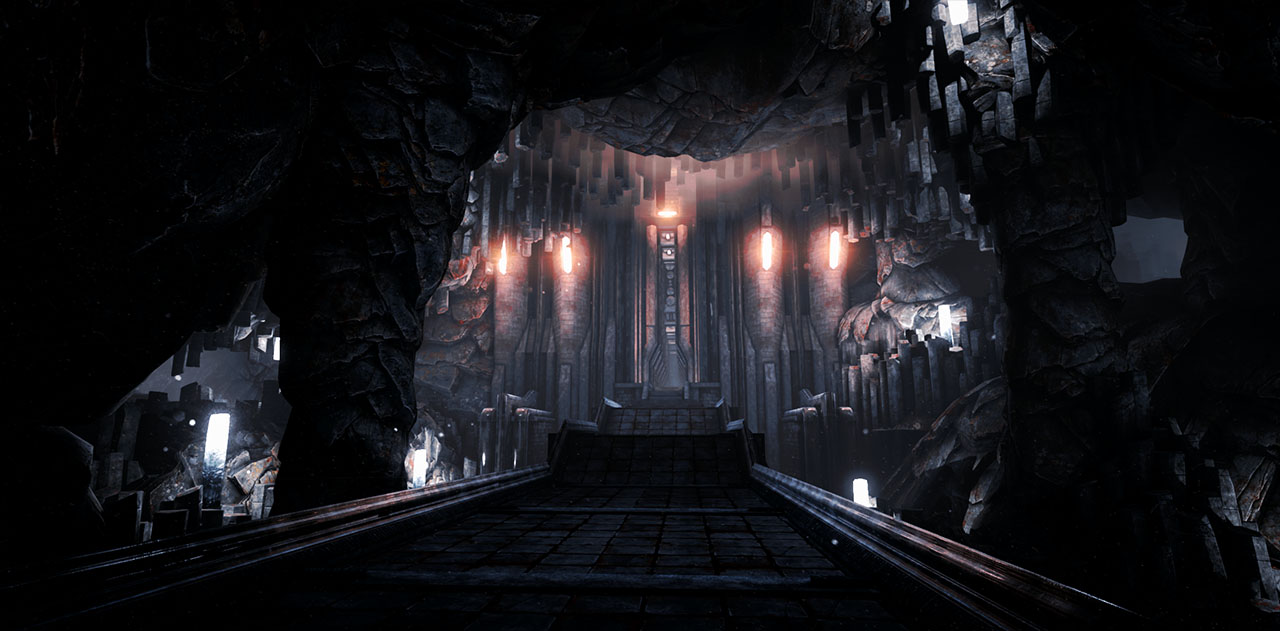
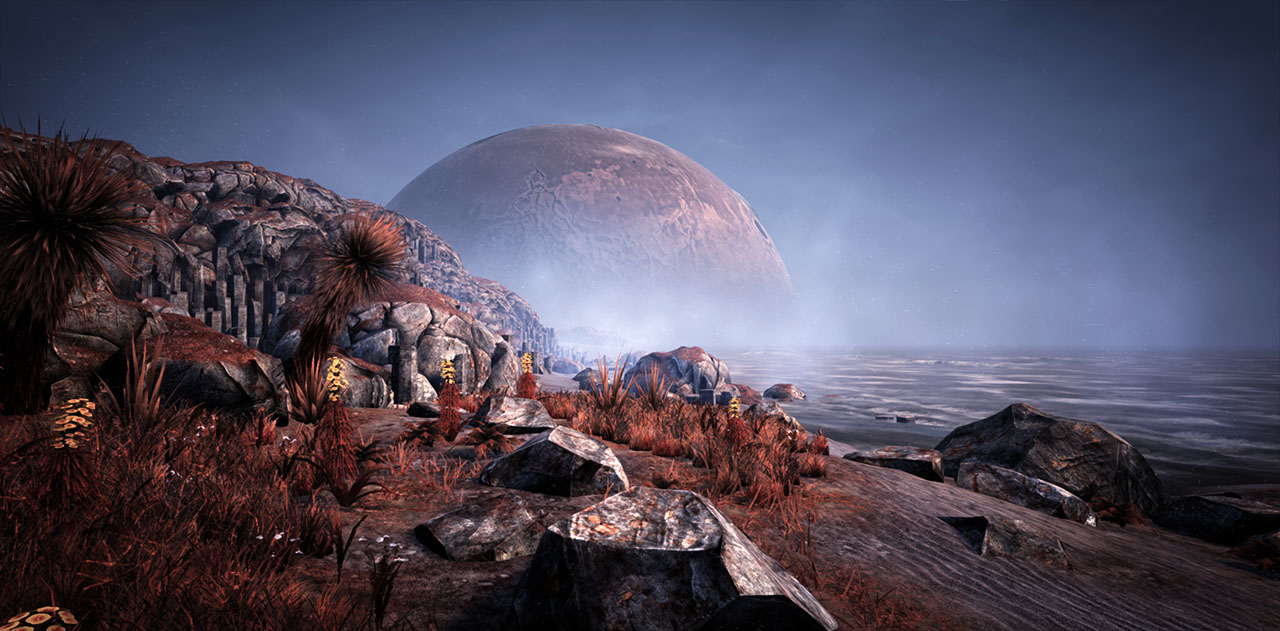
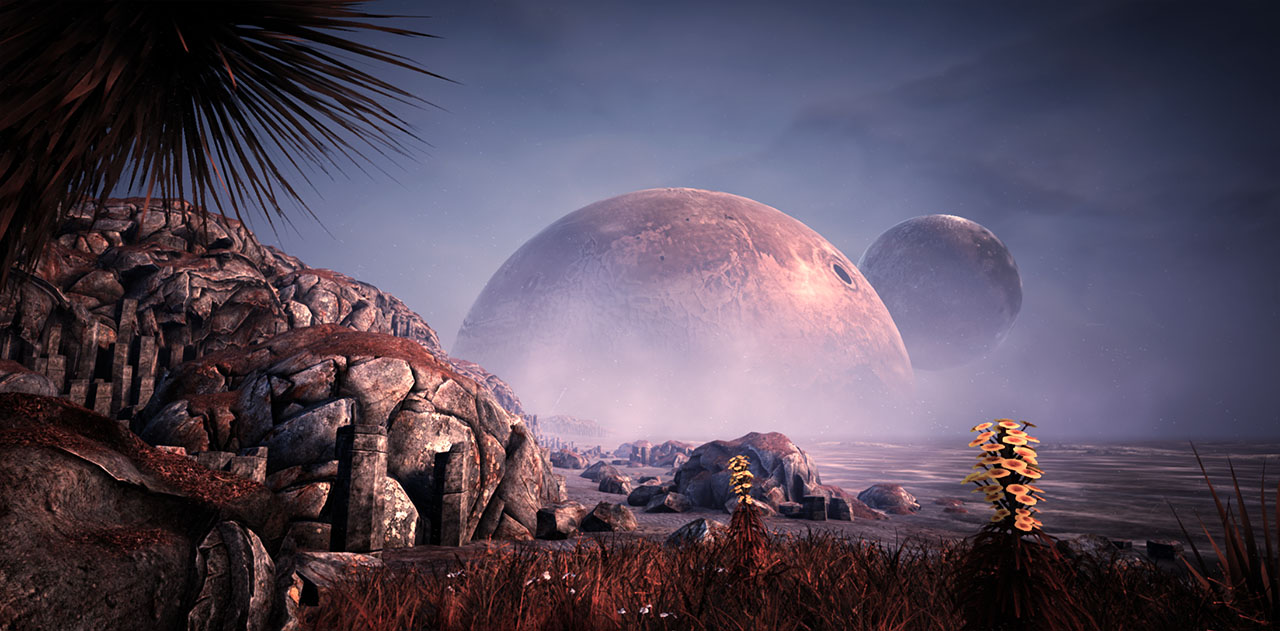
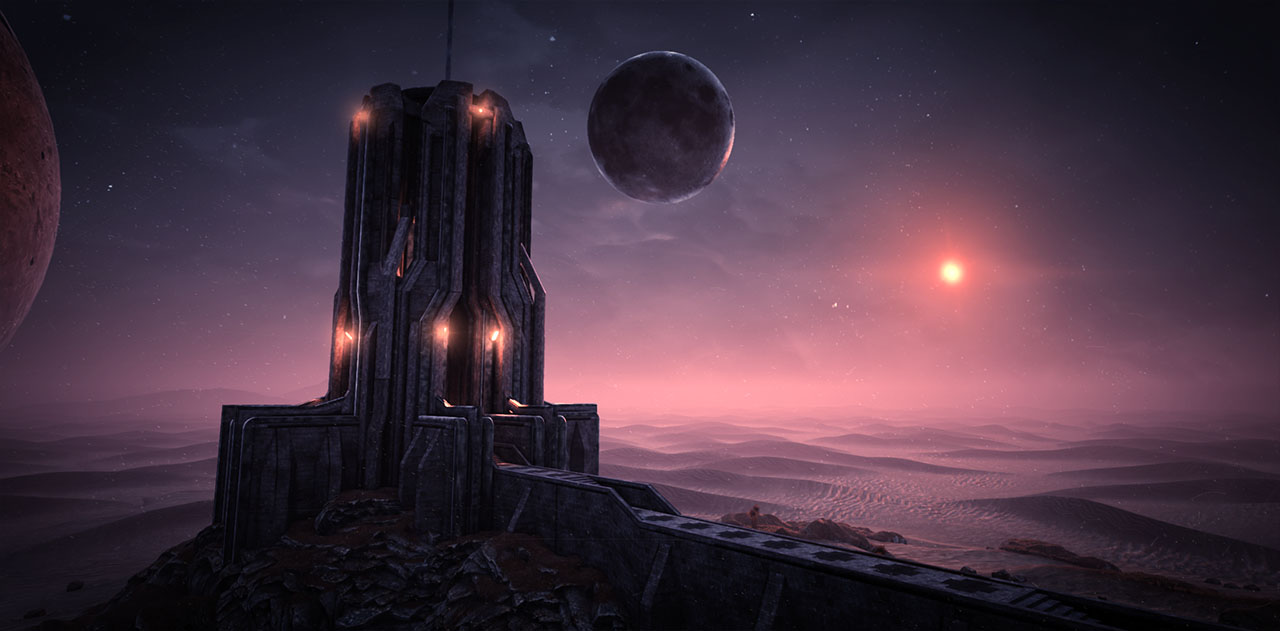
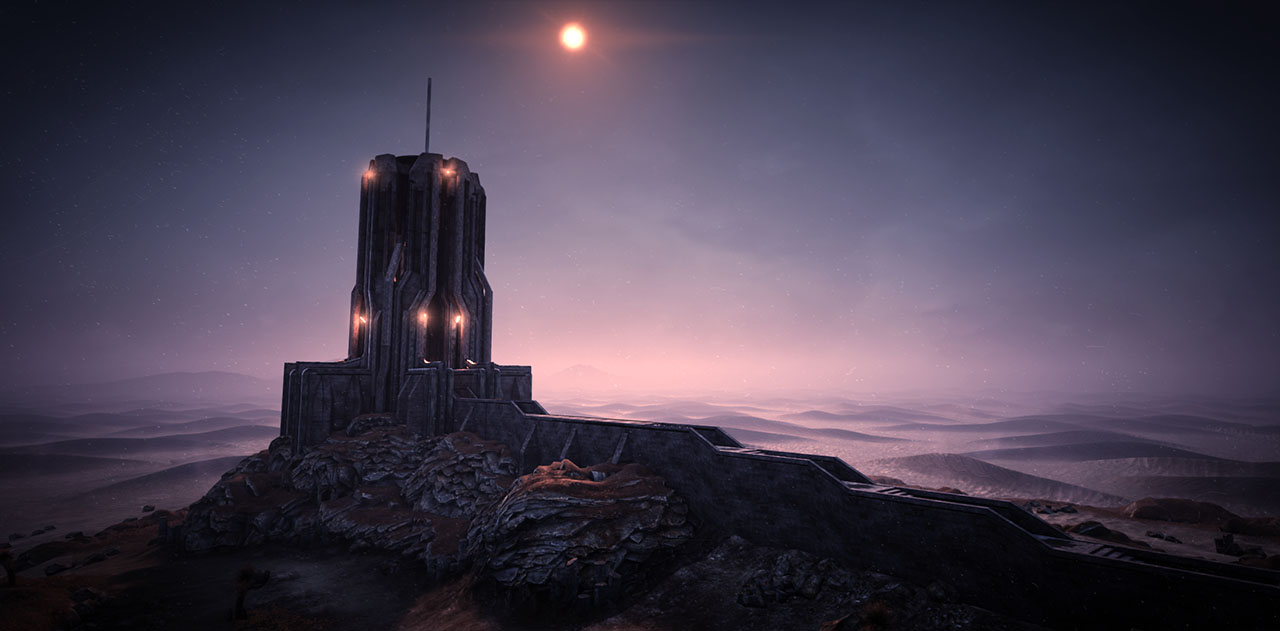
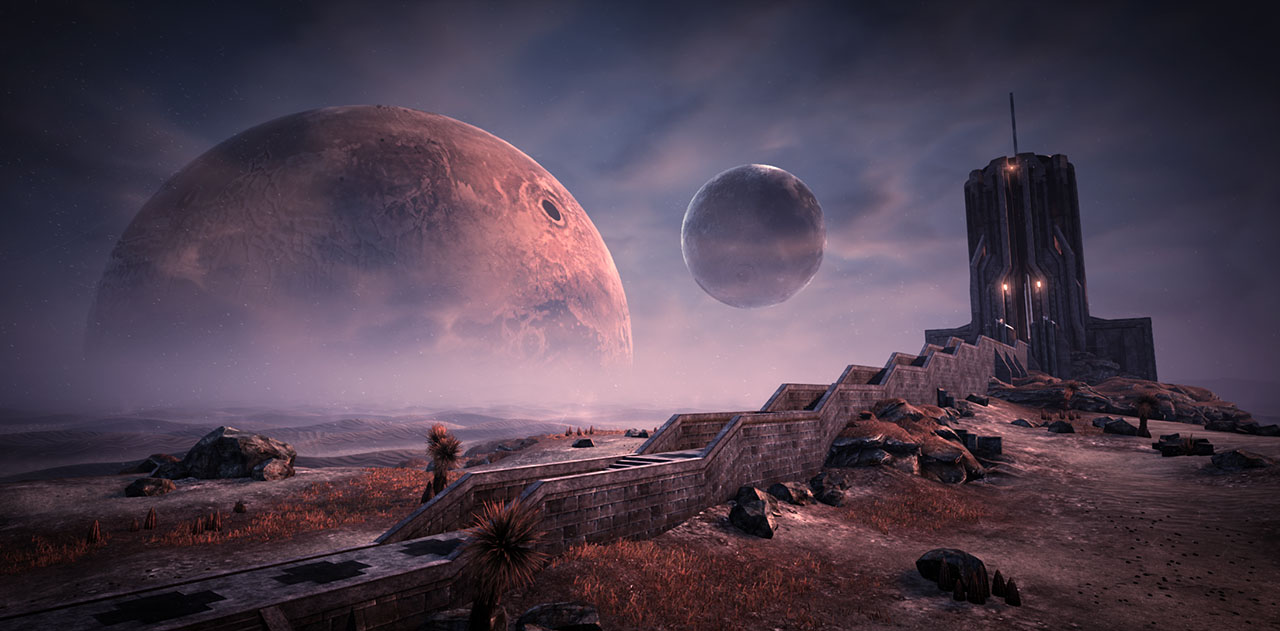
Just a quick heads up - I am one of the jury members of the new and just launched Unearthly Challenge! I am honored to be part of this and looking forward going through all the amazing art work later.
Just quickly wanted to put my discovery up here. After years of headache and having found no other artist who was able to tell me how to fix this, I just hit the solution.
When you got modular on grid meshes in Max/Maya, and you bend them 90/180/270 degrees, their ends are never ever on grid, even though the original mesh was perfectly on grid. Most people, that included me, would in that case manually move the vertices on one end and snap them to the grid.
I just found out that if you take the length of the mesh, divided by exactly 86.0576519035213, and then take the result of that division and use that to offset the center of the bend deform with into the opposite direction the mesh bends, then the end of that mesh will be exactly on grid! So for example, a 1024 long mesh that bends needs to have its bend pivot point offset by 11.899 units and it will end up exactly on the grid.
I verified this on all kinds of Unreal grid sizes. No idea how it holds up on other scales.
Two issues in the store have been resolved:
I have released 4 high end in-depth UDK video tutorials, alongside the launch of my own store!
Worth 16 hours of all my UE3 knowledge on the topics of lighting, mobile development, and asset development.
 The Expert Classes: UDK Lighting |
 The Expert Classes: UDK Asset Development – Part 1 |
 The Expert Classes: UDK Asset Development – Part 2 |
 The Expert Classes: UDK Mobile Content Development |
Features
| And last but not least, unique to my videos are the Assignments and Certificates!
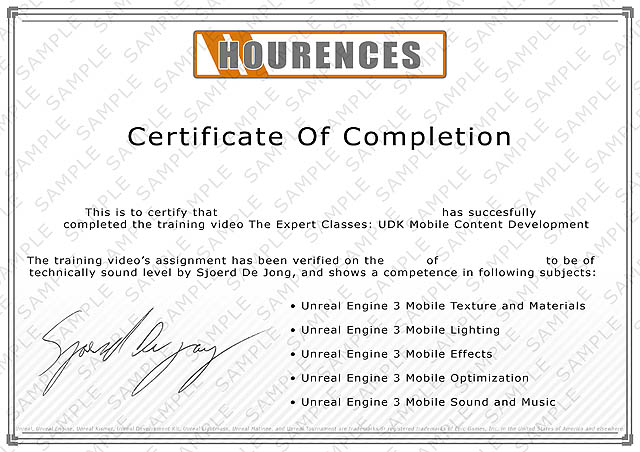
Included in every video is an assignment. These all new assignment levels or models are based on what was explained in the video, and are meant for you to demonstrate what you've learned in the video. Upon completion of the assignment, you can send it back to me and I will verify that you've done everything correctly. If all was done correctly, I will issue you a Certificate of Completion, as proof that in my opinion, you've shown sound understanding of this subject in UDK. |
 |
I am aware it is late into this generation/engine cycle, but I have my reasons to do this now. For one I did not want to let all the knowledge that I've gained working with UE3 for so many years, to get lost. I wanted to store it somehow, and make sure that other people are able to make use of it as well, as I am moving on. For example for mobile development in particular, a lot of the knowledge required to pull off a mobile Unreal Engine 3 game simply cannot be found anywhere. I learned everything by doing, as usual, and want to share that with everyone now. Late into the cycle also means that I have more knowledge to share, more examples to show, more experience to share.
Check out the Store and Video FAQs for additional information on how my store works, and what you can expect of the videos.
Thanks for your support everyone, have fun!
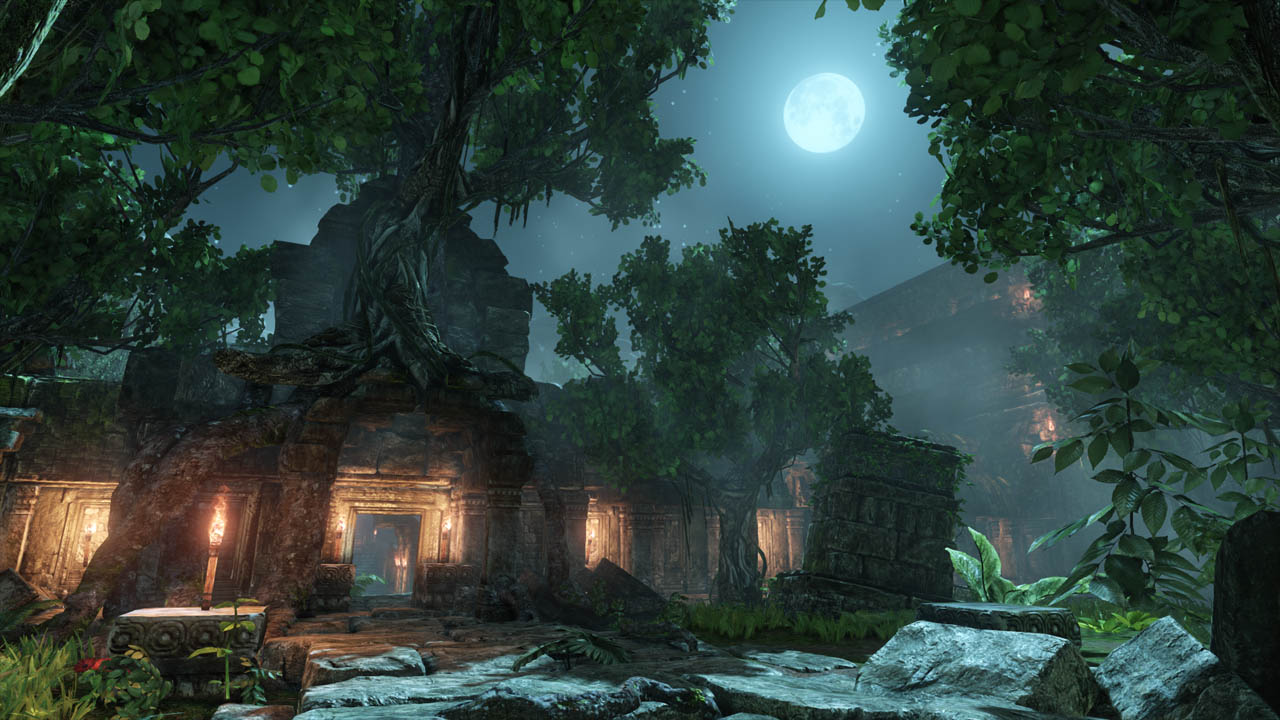
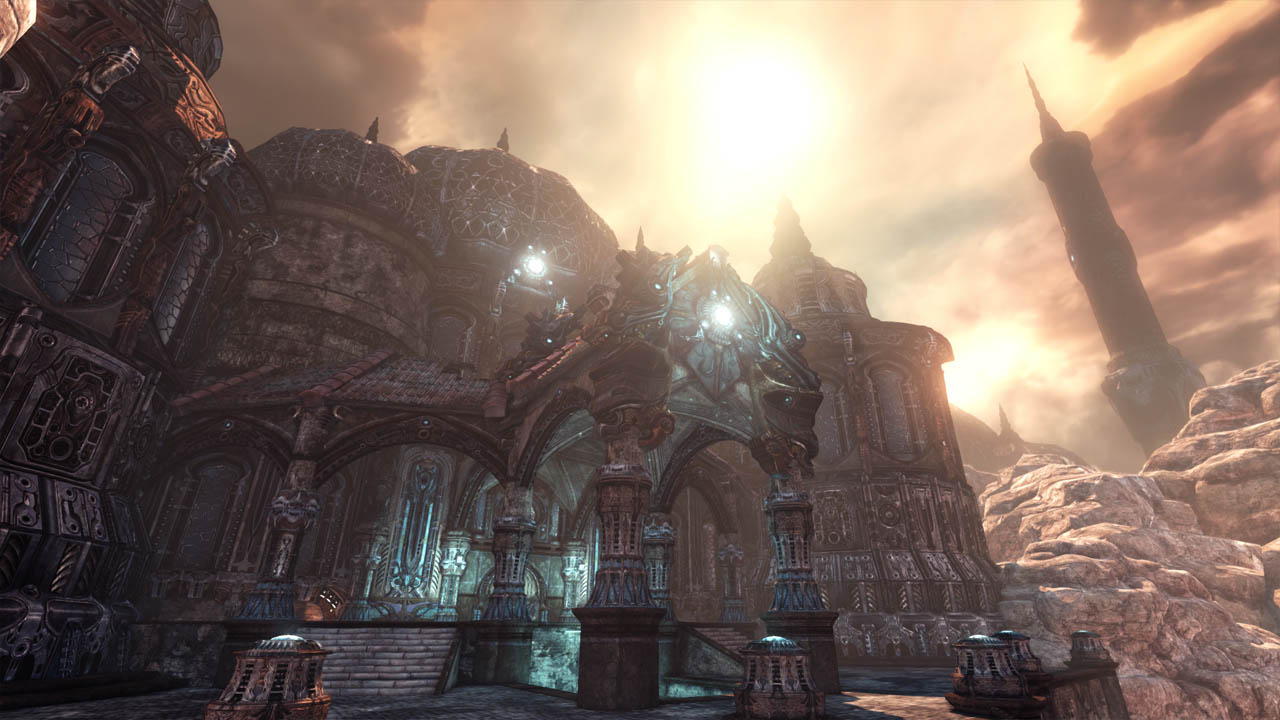
Hot on the news of Tuesday, we also just found out that Unmechanical won Best Artistic Achievement at this year's Nordic Game Awards, the yearly developer gathering and award ceremony for the Scandinavian industry.
We are all pleasantly surprised how our little game gotten so far. With no special/social features, no multiplayer, and just three hours of linear singleplayer we are very happy with what we managed to accomplish.
I am proud to announce that we've reached the 100 000 copies sold milestone with our game Unmechanical (PC+iOS)! To celebrate this we've released the free variant Unmechanical Begins.
If you haven't tried our game yet there really is no excuse anymore to give it a go and see what Unreal can do on mobile :)
Also for another 57 hours the PC version of Unmechanical is up on a pay-what-you-want basis on Indiegamestand.com. Pay above the average (1.23USD) and you will also receive two old prototype builds as well as the soundtrack in three different formats.
As for the rest I am currently still working on my secret new expansion project for this website, some level design work for clients, along with handling all kinds of things at FutureGames, our education. I've been busy following up on our internships for one. Over the past two months I've visited places like Yager, Guerrilla Games, DICE, Starbreeze, Paradox, etc. I have recently also been by the mobile games giant King to give a short lecture about Unreal Engine development to some of their devs, and over at FutureGames I am currently running the students their third and final game project. This time in collaboration with the Swedish developer Fatshark, who are acting as publisher for our students.
Last day of my daily updates. When I posted about my Rekoil and KFS work yesterday, I wrote that levels like Sawmill only took me about 18 hours to make. I recorded my screen while working on the Prison level for Rekoil, and while updating the Oilrig for KFS, and turned those recordings into timelapse videos of those levels shaping up.
The KFS Oilrig took me 2 hours 45 minutes to go from what I received from the art team to polishing it up, and the Prison level took 20 hours about + another 8 hours of unrecorded work to set up the entire level from start to end, including the creation of placeholder art. I did not prepare anything for either of these two levels/videos so what you see is just improvisation. The only thing I had when I began work on the Prison was a rough idea of the general shape and idea of the level, but no sketches or anything on paper, nor any concepts.
The Oilrig was mostly made already, but lacked effects and styling when I received it. It was particularly easy to do because it was a cutscene level, so you can get away with a lot. There were only a couple of angles to take care of and I did not had to think much/anything about performance.
There are some things that I could have done better, or put more time into if I would have had that, for example the outside of the Prison is rather flat whereas the inside has the tendency to be cramped plus too disconnected from the outside, and the inside also has a bit too flat lighting and detailing going on, but those smaller problems aside, as an illustration of my drive for efficiency and my usual no-nonsense-just-do-it approach to everything I create it gets the point across. I want to give my clients fast but quality results because my time is their money.
If you have epilepsy/photosensitivity you should probably not watch these, the screen jumps around aggressively and it goes really fast.
Portfolio
I have finally gotten around to updating my portfolio. I updated some info, added a 5th level page for the era 2011-Today, and added all the work that I have done in the past 1.5 years about that was missing, and I also made the website more compatible with iOS devices.
Rekoil
Still working on Rekoil. We are moving forward at a solid pace, though like usual things end up taking a bit longer than expected. We are still very much so in need of your support on Steam Greenlight.
Here are the levels I have worked on. Many of these were team efforts. Details on who did what are on my portfolio’s fifth level page. In general I did little gameplay design on these, and was mostly responsible for the level art side of things. I did a lot of the detailing, some of the major architecture, and I set up the lighting, texture and light color pallets, effects, etc. Overall look and feel basically, visual polish and styling.
Levels like Sawmill I am particularly proud off. I made those entirely myself, and I did it super fast. You are looking at just ~18 hours of work from start to end. I got more on that tomorrow in the form of two videos.


Kung Fu Superstar
I did some quick work on their new environment a while ago, video of that coming up tomorrow. The team tried to get funding secured via Kickstarter, as one of the first UK teams to go onto Kickstarter + with testimonials from people like Peter Molyneux but none of that seemed to have helped. It never met its goals so the project was canned unfortunately.
Here are some screenshots of the newest environment I worked on plus some new shots of the previous stuff I helped out on. I mostly did visual polish and special fx/materials/lighting work. Credits to the whole KFS team for all the rest.


Day three of my 5 days of updates!
Unmechanical was awarded Best Game & Best Sound at BIG, the Brazilian International Games Festival.
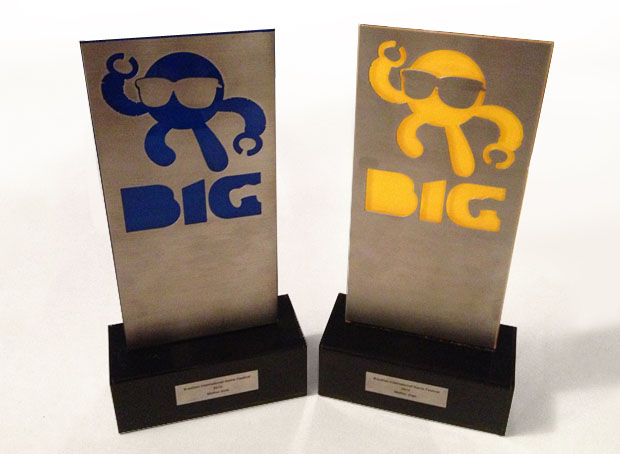
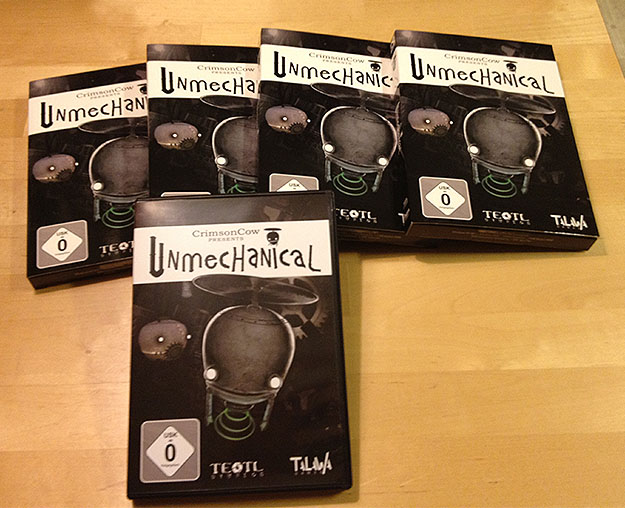
We also received some boxed copies of the game, of our German retail distribution partner CrimsonCow
iOS wise we are quite a bit behind on our schedule. We had planned to release the iOS version of the game in September, but that obviously didn’t happen. We discussed the game with some external people and came to the conclusion that in order to for the game to have a reasonable chance of success, we had to support more iOS devices. The original plan was to go for iPad2 minimum, but over the past 4 months we’ve been hard at work at further optimizing the game, and we can now proudly say that we got the game working on pretty much every single iOS device out there.
We are now supporting iOS4.3/iPhone3GS/iPod 4th Gen/iPad1, and everything newer than that. We did tons of heavy modifications to all of our content and to the engine itself. I’ve learned a huge amount of deep technical stuff by doing this kind of work the past year, so it has been very valuable on a technical level.
The game is scheduled for release some time later this month, or in February. Most likely. No promises there.
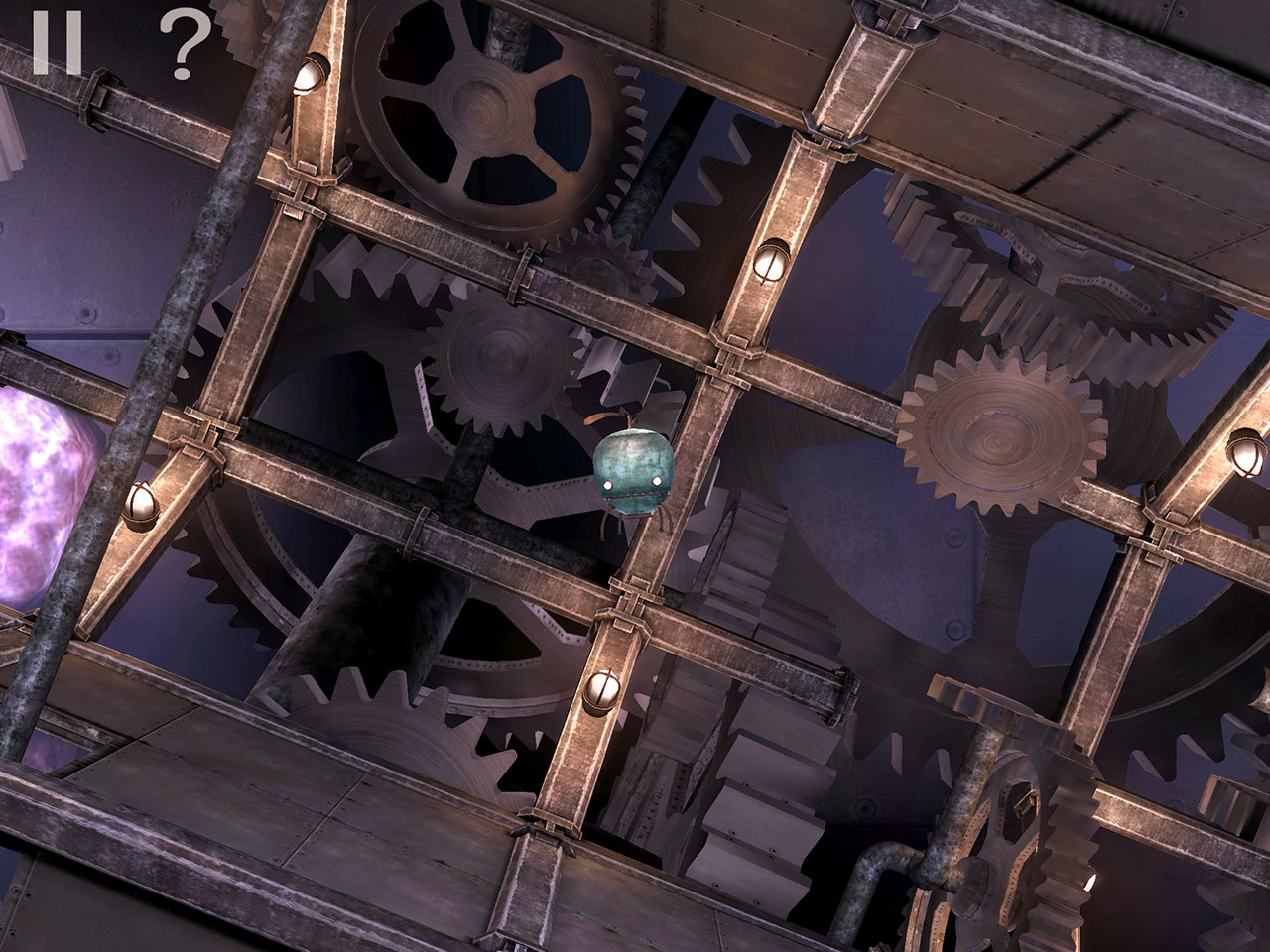
Some new iOS screenshots. These are in-game shots of the game running on iPad4.
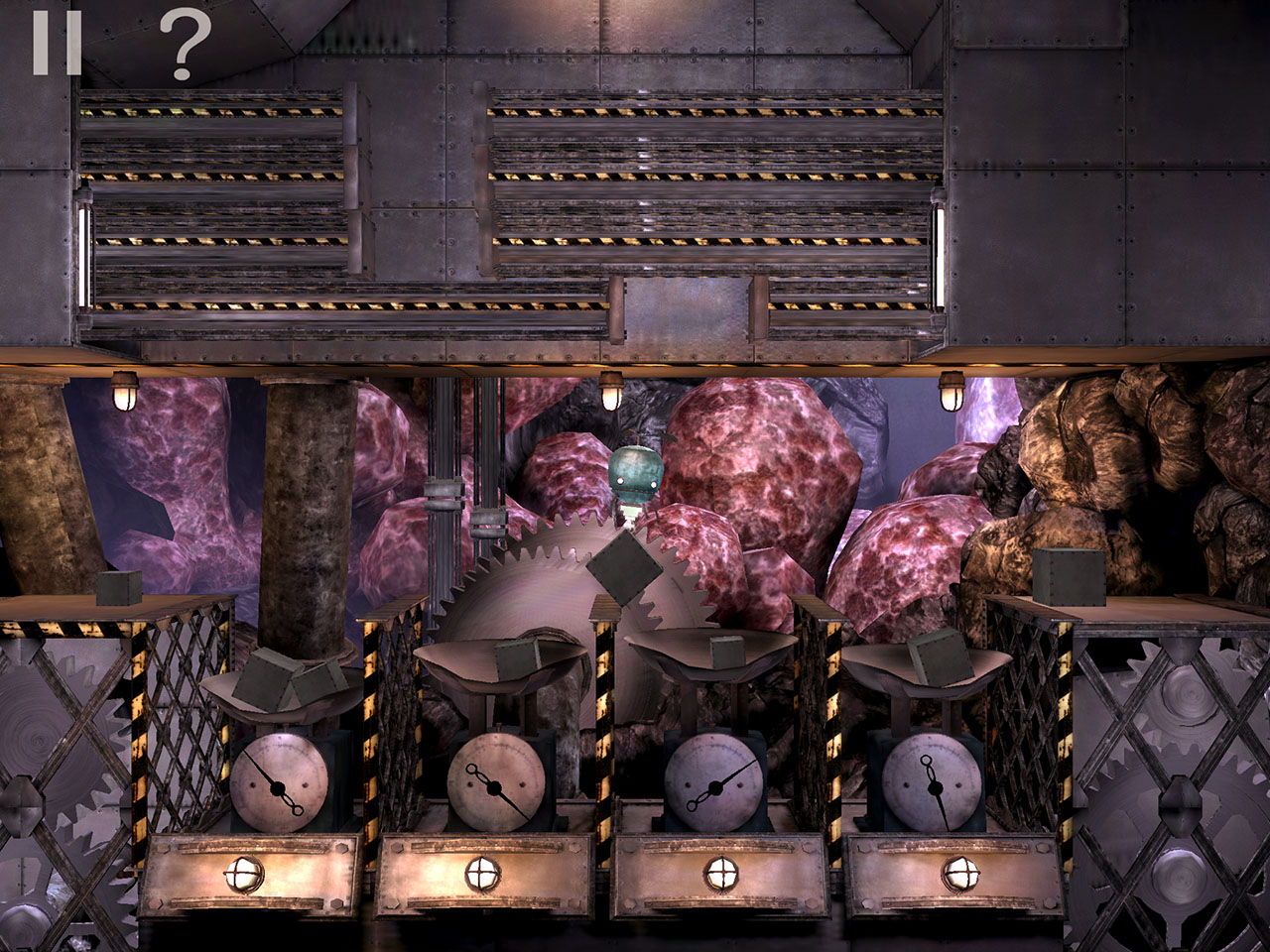
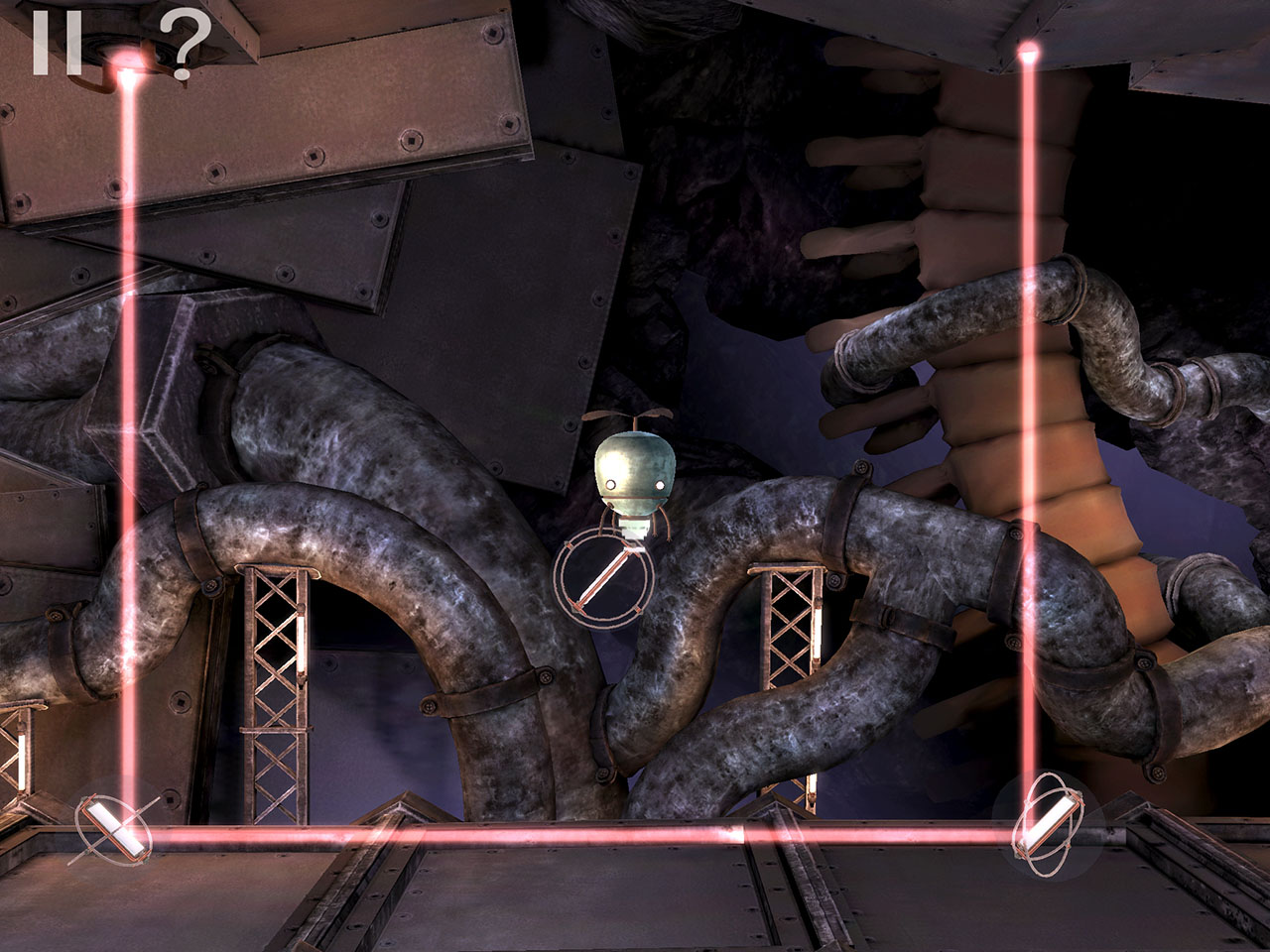
Huge update tomorrow! Dozens of screenshots of my latest levels.
I’ve been interview and featured in The Games Machine, one of Italy’s biggest gaming magazines. Thanks to Carola Cudemo from indies4indies.com for setting it up!
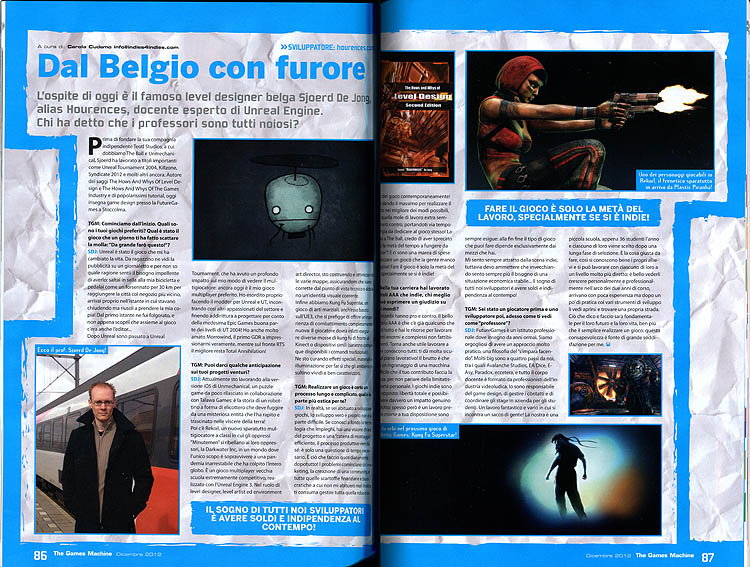
Got some new Unmechanical media and info tomorrow, with dozens of screenshots of all my recent work and some timelapse WIP videos coming up day 4 and 5.
I am going to post one update a day for rest of this week, to give you an idea of everything I have been up to in 2012.
Hourences.com
As you may have noticed Hourences.com got updated.
FutureGames Class of 2012 – Game Project 1
I am still teaching at the education FutureGames, and once more we’ve thrown our students into the deep end right away. I think the results have been particularly good this year.
Together with Tobias Lundmark I made a video of these games. All footage was captured directly from an iPad2.
Second post of the day, while we are at it I want to voice my thoughts on Steam Greenlight. I think the basic idea is good, but it is far from where it should be right now.
For example this is currently the most popular, or one of the most popular games on Steam Greenlight. With all do respect, but I don’t see how that will make it into a finished game. On the other hand there are games out there with development budgets of hundreds of thousands if not millions that do not get much attention because they are flushed away by the sheer volume of games added all the time, many of them tiny productions or just plain ideas. A day in I already do not know where to begin looking at the games. And the more fluff there will be on Steam Greenlight, the more the average viewers will step out, and the more the system will be controlled by a small hardcore crowd with too much time on their hands I believe.
This game for example was posted on about the same time as the aforementioned game, looks like a much more complete and functional game, yet has almost no votes whatsoever. And how about this game. Been posted fairly recently, but has much higher budget and production values.
There are also plenty of trolling attempts coming by. I saw Battlefield 3 floating by in Russian earlier today, and a game with pictures of Anders Breivik.
All too often with things like these it are not the good products that make it, it are the “dreams” that get popular. Sell an idea that makes people dream, say for example Building a Colony on Mars or Oyua and you will get yourself plenty of attention. Dreams aren’t playable though. Games are. It should always be about products, not about dreams. It does not matter how awesome an idea is, if it does not make it into a finished and sustainable product it is utterly irrelevant.
I would love to see the entire system more business focused and not gamer focused. I would try to keep the average viewer returning to Steam Greenlight as much as possible to reduce the risk of getting the entire system run by a small group of users, and I would do that through:
The irony of the whole indie revolution is that so many people got into it, that in order for the whole thing to continue to work it will fall back into almost exactly the situation we came from about five years ago. In order to stand out, get attention, and make it through all the gatekeepers like Steam or the console developers, you will soon need (and often already need this kind) a publisher who can open the doors for you that you need opened. I know plenty of developers who approach traditional publishers just for the sake of getting a spot on Steam or XBLA, because they cannot manage on their own. I don’t immediately have a solution for that either. There are just way too many games out there.
Rekoil
Since February this year I have been working as freelance level designer/artist/environment art director on the competitive FPS Unreal Engine game Rekoil
A first trailer has just gone up.
The game has also gone up on Steam Greenlight... [Content cut off]
And here is game number two that I’ve been working on!
Press release:
Today, indie developers Talawa Games and Teotl Studios are thrilled to announce the puzzle adventure game Unmechanical, to be released August 8 2012 for PC and a couple of weeks later for iOS.
Unmechanical is an award-winning 2.5D side-scroller which combines tricky puzzle solving, alluring exploration, and an engrossing atmosphere. The game had humble beginnings as a student project and since then both game and team has grown.
“Unmechanical has been about taking on something for real and working our fingers to the bone to get it done. It’s our hopes and ambitions combined into this very personal, unique, and awesome adventure that’s crafted with lots of love.” Said Marko Permanto, project lead for the Unmechanical team.
Unmechanical begins with a twist of fate as you’re spirited away by a network of coiled pipes into a mysterious underworld. You find yourself in a strange environment that pulsates from mechanic and organic machinery alike, and your journey to freedom begins. Flying freely through the odd and fantastic surroundings, a powerful tractor beam lets you pick up objects and interact with the world.
Your quest for freedom requires you to solve a great variety of puzzling challenges, and while it’s easy to pick up and play, later challenges may prove very difficult indeed. On your adventure you might also begin to understand what it all means–The underworld may be more than it seems, the fateful descent more than just chance, and you might not be entirely alone after all…
For more information about the game, visit Unmechanical at http://unmechanical.net/
The game started out as one of the game projects at the education Future Games where I teach. Originally put together in just 4 weeks, the little demo was received so well by everyone that the team decided to carry on with development. And that eventually led to the cooperation between Talawa Games, a new studio started up by part of the original team, and my own company Teotl Studios.
I joined the team about 8 months ago to get the game through its final stages of development. I have been responsible for optimizing all the art and levels, as well visually polishing up all the areas and ensuring the looks and style are consistent throughout the entire game. I also took care of the large majority of the PC to iOS conversion work. Tech/Level artist would sum up my work quite well. My own development work aside, as a company we are helping them with Steam and other business and distribution things.
The iOS version in particular is something that, from a tech perspective, I am particular proud of. We will be revealing iOS shots in the next couple of weeks but I managed to pretty much translate the PC looks to iOS near 1:1, including normal maps and so on at near no performance loss. I’d really like to produce one or two training videos to go over these iOS Unreal Engine tips and tricks I’ve learned later this year, though I am so very out of time all the time so we will see!
Other than this game I’ve also been busy handling the internships at Future Games the past half year. Following up and assisting our students throughout their six month internships, and visiting them at the various places where they went. That got me to visit a wide range of studios over the past few months, ranging from the biggest like Guerrilla Games and Dice to small two man indie teams like Oxeye Studios, the guys behind the indie 2D shooter Cobalt. The contacts aside, one of the big things I got out of the whole experience was probably the industry wide (for within this region at least) perspective and overview on how the industry is moving along.
As promised a while ago, the first of several projects I am currently involved in!
Kung Fu Superstar is an Unreal Engine martial arts game, and we’ve just released the anouncement trailer, along with an interview over at Eurogamer
I’ve helped them out by polishing and beautifying all the environments in the video. Lighting, particles and other effects, post process and color correction settings, skies, advanced materials, and so on. Also did some work on character materials and lighting setups.
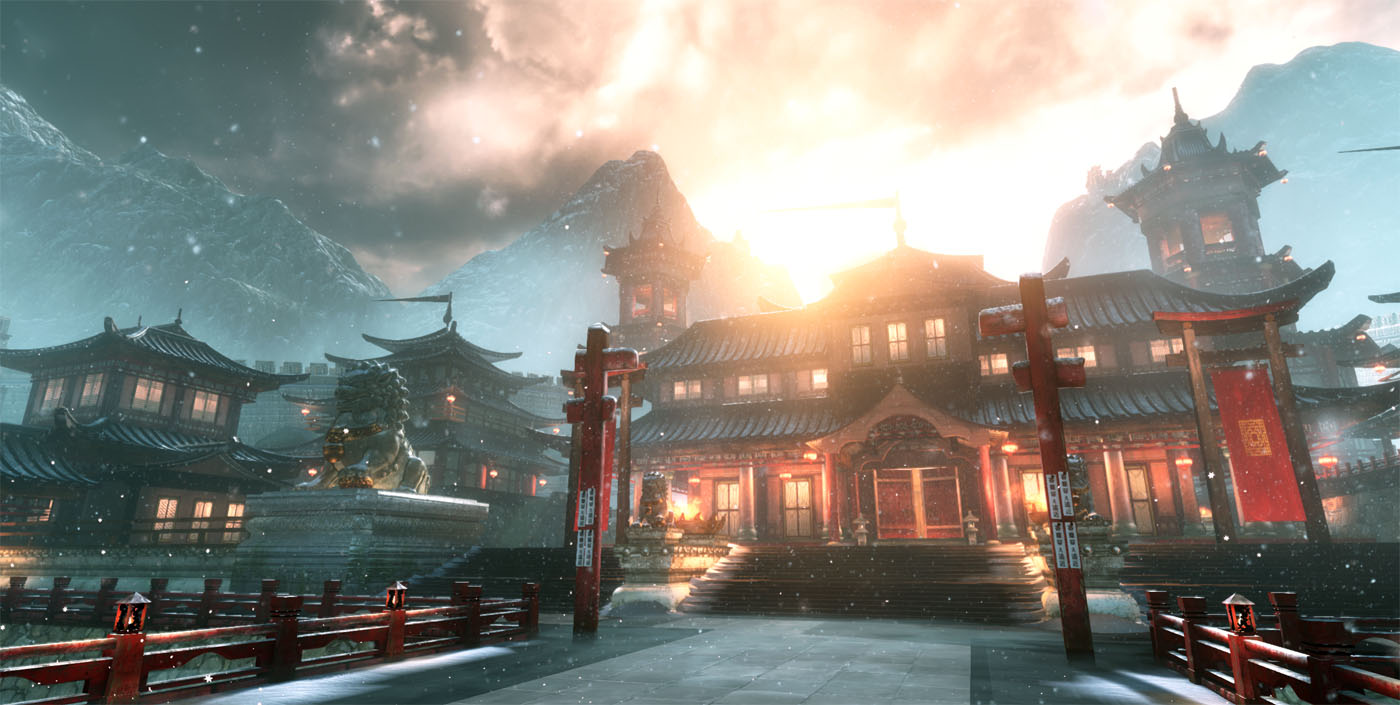
Was great fun to do! I like the polishing stage the most of all steps, to really take an environment to the next level and make it shine, so I’d definitely be up for something like this again if anyone else similar projects going :)
More new stuff in a month, or two at most!
I am really busy with a hundred different things these days. Working on three different games, alternating daily between each of the games. Can’t show anything just yet, but by summer it should all be ready, if not released even! Last year was a bit of a slow year, but this year I am getting back up to full speed!
I am getting really good at mobile Unreal stuff also lately. I just managed to get large open high poly landscapes going on Ipad at 60 FPS, a mobile foliage system, smooth gradients with absolutely no sign of compression, normal mapping and pseudo specular without dynamic lights and with almost no performance impact, some cool usage of flares, and so on. One on the games I work on is also running on both PC and iOS using the exact same files and levels, I managed to get it to scale in both ways without compromising on both performance for mobile, or looks for PC. I plan to write tutorials on these, or make video tutorials, once I got some more time.
Also, Syndicate got released a few weeks ago. It is the game I worked as level designer/artist for the first 1.5 year of pre-production/production, until I left to work The Ball fulltime.
Otherwise I am still occupied with teaching and education. I am handling the internships for last years students and some day to day business at my school Future Games, and tomorrow I am starting a 4 day UDK course at a University in South Stockholm.
Couple of weeks ago my students over at Future Games completed their second Game Project of the year, again running on UDK.
Like previous times:
People in Sweden who interested in our school can attend our presentation March 22nd. We take in just 36 people a year and all of our teachers are industry people.
Goliath
Goliath is a side-scrolling puzzle platformer with a shooting element. Play as a seek and rescue bot as it tracks a distress signal deep into the wreckage of a downed mother ship and discover where you are and how you ended up there. Overcome hazards and enemy turrets as you progress through 4 distinctive environments to reach your objective.
Memento
A man, old and dying lies jacked in to a machine designed not to save his life, but to judge it. He is being forced to relive his memories, both joyful and horrifying, in the largest public trial since those of Nuremberg. The whole world watches with horrified anticipation as the hated old man spends his final hours reliving bloodstained fragments of his dreadful life.
Rennfahrer
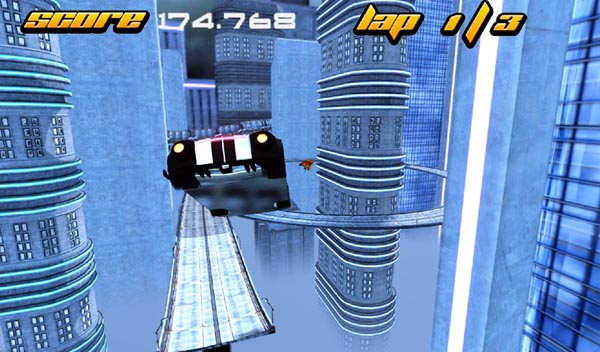
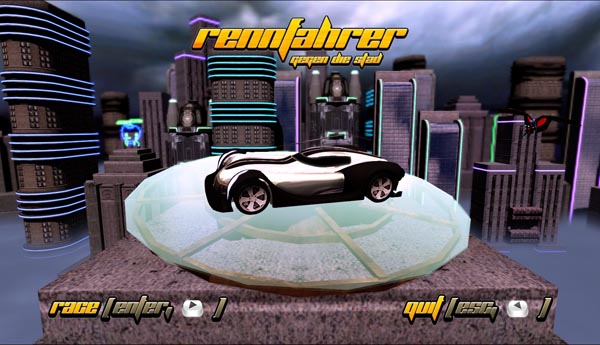
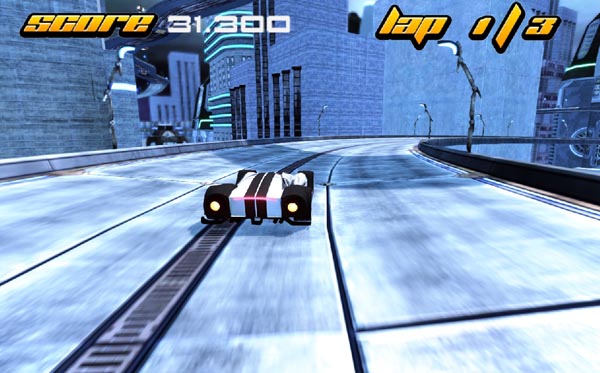
Rennfahrer is an high octane racing game set in the near future. Burn through a stunning city vista high above the clouds while trying to stay alive as the cities defense system tries to hinder you from reaching the goal.
With games as “Wipeout” and “Trackmania” as inspiration, buckle up and get ready for adrenaline pumping speed and insane jumps as you race against the timer and drive for your life!
The Box Project
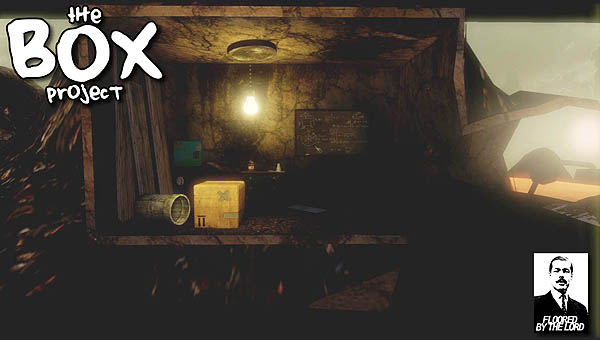
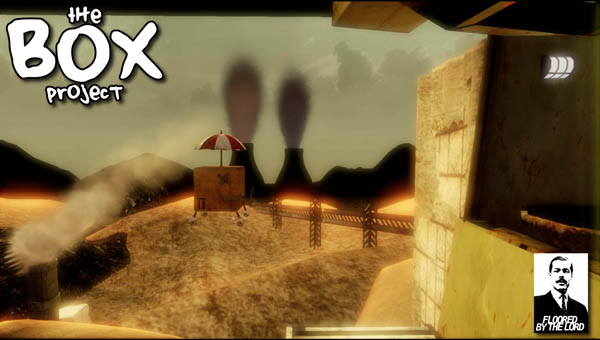
The Box Project is an environmentally puzzling platform adventure where you control a swiss-army box. The box contains all the contraptions needed to save the over-polluted world that remains, now that the humans have left for newer worlds. Spring over the junkyard, float through jets of steam, and collect fairies on your path to cleanse the world and make it anew.
Alex the axolotl
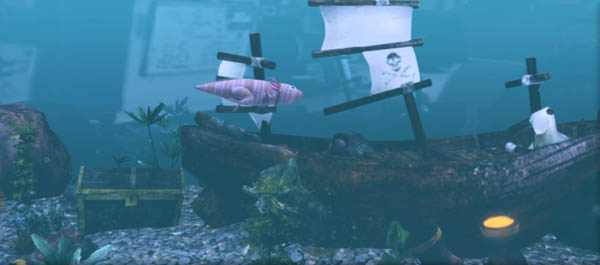
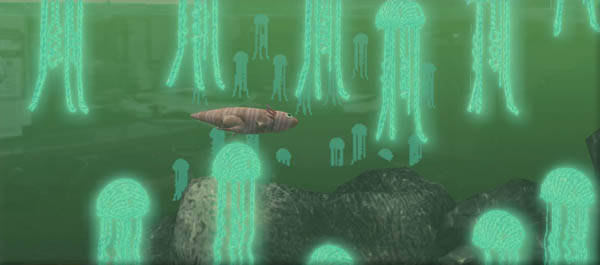
You play as Alex, a axolotl. You and your family gets taken from your natural habitat by man.
Set in a aquarium where you will have to swim through dangerous environments to try and find out what happened to your family.
Bad Luck
Bad Luck is a game which involves two different types of gameplay, a fast paced side scrolling shoot ‘em up, and a top-down logical puzzler. Each level swaps between these two modes in a challenging and different way, always keeping the players mind and reactions alert. You control a character whose bad luck has left them stranded alone on a planet, trying desperately to make their way to the surface. Unfortunately, bad luck keeps sending you in the opposite direction. With the help of the character’s various abilities (shooting, grabbing, dashing and manipulating time) it’s up to you to reverse the players luck and make your way out of this predicament.
I’ve updated the Simple UDK Game tutorial to reflect recent changes in the engine, and I’ve written an all new tutorial for a brand new Kismet HUD/Interface system!
This new system, written by Marko Permanto, and based on James Tan’s UI Kismet system allows you to build, control, and animate menus and HUDs through nothing but Kismet!
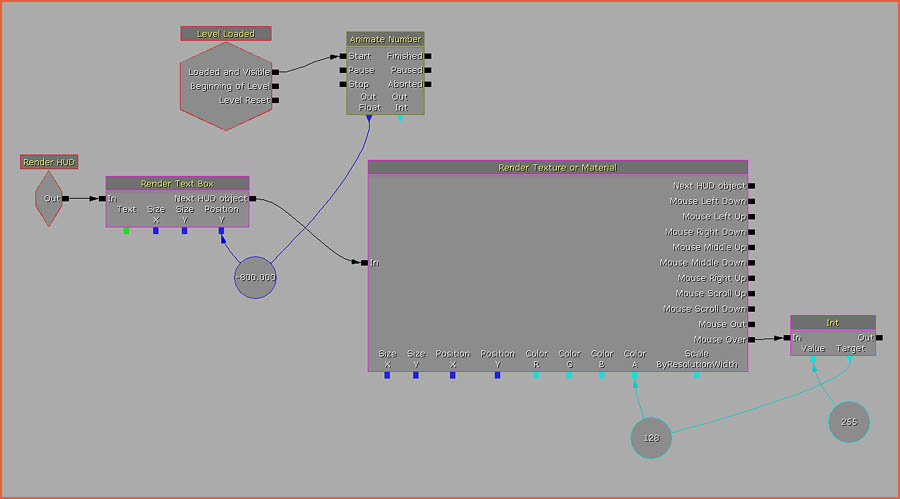
I’ve never gotten into Scaleform. I’ve always thought it is ridiculous to require someone to get and learn Flash and Actionscript just to get a little image to appear on the screen. When making indie games and prototyping concepts you need to be able to get result as fast and as easy as possible, and these Kismet blocks are a major step in the right direction in my opinion. I can make stuff appear on the screen again! Hurray!
We will be using this system in the upcoming UDK game Marko and I are working on – Unmechanical – Join us on Facebook also! We are hard at work at getting the game done at the moment so for the time being we don’t want to spend too much time yet on releasing screenshots and videos and all that, but we will soon begin ramping up our media efforts :)
Last September I started my annual fall and winter lecturing at Future Games. Normally we start the school year by having the students create a couple of traditional board games, followed by a few months of regular teaching before we let them make their first full games. Contrary to previous years, we decided to throw them in the deep end right away this year and have them make their own games after just 3 days of teaching!
At Future Games we are convinced that the best way to learn game development is by doing it. Theoretical knowledge is important, but at the end of the day you learn the most by trying things out, and by experimenting. Like many other developers who’ve started out before the era of “game development educations” I got into game development by making one level after another, one mod after another, and so on. We are trying to capture that spirit of proactive practically focused entrepreneurship many game developers in the industry have, in our education. If anyone in the vicinity of Stockholm would like to visit us, we regularly organize informal evening get togethers – follow the event on Facebook for information on when.
Either way, here are the results from our 35 new students and two weeks of work:
Knugen
In the age of knights, honor and treachery, the black (and merciless) king has been ruling the green lands of Landora since he slew the white kings father, who had been a just king for decades. Now the white king is eager for justice and to reclaim what (he believes) is rightfully his! Can he succeed? Or will the black king continue to rule it with an iron fist?
Knugen is a turn based, strategic two-player game where you affect your opponent, either by griefing him or helping him, by grabbing the goodies on the way to the throne. One must also beware, the race for the throne will awake blind spirits of fallen warriors from past times to fulfill their pledge to defend the throne from intruders!
Swipe in the direction you want to move and stomp your way through your opponent and the ancient, beautiful hallway to claim the throne for yourself! A quick and fun game with unlimited replayability to play whenever you want to show your friends who the real king is!
So, which king will prevail? The fate of Landora is your hands.
Mischief

“MISCHIEF!” is a family friendly multi-player game that features classic gameplay, that fans of traditional board-games will appreciate. Control one of four mischievous goblins seeking to earn their riches, and purchase the four mystical trinkets from across the realm. If things aren’t going your way, throw down a ‘Mischief’ card that will mess things up for the other players – Steal their items, teleport them away or just make them lose their precious gold! Featuring simple intuitive controls and cure colorful graphics, “MISCHIEF!” should keep you, and maybe your own little Mischiefs, entertained for hours!
Polarity
Polarity is based on a boardgame we all remember from our childhood: The Labyrinth, more commonly known as “the one where you tilt the board around to avoid the ball from falling into holes”.
Contrary to the original game, tilting the iPad has little effect on the direction of the ball. Instead you are to travel around the board attracting and deflecting yourself from the magnetic power plants by switching their polarity.
They See Me Rolling

Experience the next generation of labyrinth games! They See Me Rolling brings new life to an old genre, using open environments, dynamic obstacles and a revolutionary advancement system. Controlling a lonely and previously immobile rock yearning for the power of flight, you must navigate unique environments on your quest to steal the sandals of Hermes and finally fulfill your dream.
Jungleprod

Jungleprod is the latest sensation to hit the iPad! Using the iPad’s touchfunctions you will get a truly breathtaking experience swiping through the jungle! Tread carefully because the jungle is as lively as ever. Beware of Crocodiles, monkeys, and other jungle critters on your way to the treasure!
I have written a new UE3 tutorial: An introduction to Performance Profiling
Also, the 3DSMax Batch Export script has been updated with a small bug fix – Thanks “Keen”!
Currently going through my yearly fall and winter teaching sessions at Future Games in Stockholm. First thing I had the new class of students do this year was to build a UDK iPad board game, after just three days of teaching. The results were impressive, I will put it up here in my news later this year!
New tutorial!
I have written a step by step walkthrough tutorial on:
nDo2 is a new tool that hooks into Photoshop, and allows you to paint and draw normal maps directly in Photoshop.
As I posted on Twitter a few days ago, the game that I worked on before I started up Teotl Studios to work on The Ball full time just got announced by EA: Syndicate.
And related to that, I thought this was quite a nice parody.
That aside, I recently read through a couple of game design books for my course at Future Games.
Spending the month in the Philippines at the moment of all places. Vacation. Great place. The climate is a bit too warm perhaps but life feels free and relaxing here. Flying back next weekend, and then I will begin teaching my regular yearly courses at Future Games until February.
My friend Teddy and his colleagues over at Quixel have released the nDo 2 beta! I can highly recommend it. It allows you to paint and modify normal maps directly in Photoshop, and as I never really got into all that Zbrush and Mudbox stuff this is really the missing piece of tech I had been looking for for a long time. Go check it out.
I came across a couple of interesting articles, books, and a program:
Dave’s Mapper – A top down map generator. Can’t really use it for anything serious, but it may give you some inspiration when you try to come up with a floorplan. It is actually remarkably UT’ish/Quake’ish what it generates :)
Modular Environments in UDK – A tutorial from my friend Thiago Klafke on creating modular meshes for use in the UDK (or other engines if you wish).
Motivating Players in Open World Games - An article on game and level design in open world games from someone from Bethesda.
Spacescape – Free star texture generator.
Also I just bought a couple of books, two most notable ones are:
Pictorial Encyclopedia of Historic Architectural Plans, Details and Elements – Reference guide with nothing more than side and top sketches of parts of historical buildings.
Architecture Form, Space, and Order - Very readable. Just enough text, and thousands of pictures. Really nice book if you want to developer a better understanding of architecture and you don’t want to read hundreds of pages of heavy academical text.
Also have two game design books to still go through, and a book on castles. I figured since games are usually about assault/defend, lets read some in-depth info on castle design.
Long time no update again, there goes my promise of updating more regularly :) It is quite hard to find the time with all the other things I am doing.
I made some changes to the site. I removed a directory with images that were normally no longer used (I hope) and I fixed a few broken images and bits of text that messed up when it got ported over to WordPress. I also moved all large images back from the secondary host to the host the website itself is on too, after someone complained he could not see the externally referenced images. They should also load faster now. Let me know if some images ported over incorrectly.
I am currently working on some mobile Unreal Engine projects. I am working on a small kismet only mobile game that will be used for a new video for Eat3D, and we are porting over The Ball. We got it running at 30-40 FPS all the way through the first 3 levels actually, so that is really promising and these mobile devices are getting really powerful lately. More on that later when things solidify a bit more. Will also be traveling a lot later this year for a long vacation, and I will be back to teaching at Future Games in fall, until late winter 2012.
Quite a few stories popping up lately about excessive crunch and other such scandals. First we had the LA Noir Credit scandal and the stories about management and excessive crunch, now horror stories about Gameloft in New Zealand surfaced. It is really disgraceful, criminal even as far as I am concerned. I read a story of a a guy who was made to work 16 hours every day for almost half a year long while having a 3 month old baby at home… That shows just how incredibly immature the industry still is. Meanwhile the IGDA which is suppose to represent and defend our interests as developers has proven yet again that it really does not care for its members and is unable to stand up for us. This is just one out of many scandals that they have failed to respond to (Tim Langdell anyone? – and check out his amusing performance in court too), making me wonder exactly what its purpose really is…
There seems to be growing awareness of the excessive crunch problem though, even among junior developers, and each and every one of these stories that surfaces will further our cause, but there is more to be done. We need an increased awareness and opposition. Excessive crunch without a solid and fair compensation package is absolutely unacceptable!
A website dedicated to the topic popped up a few days ago: I Love Crunch
I finally found time again to write a new tutorial, on Eastern of all days. The new tutorial is about Texture Optimization and talks about lowering the memory footprint of your 2D assets in the UE3/UDK. I intend to finally go over the 3 material tutorials whenever I find time again, as those are desperately in need of an update.
I also wrote up a post mortem on the things we did for the Portal 2 ARG/Potato Sack. There is quite a big section in it about the level we did.

Now that I finally have near unlimited bandwidth and diskspace on this server I was thinking if I could perhaps extend my site somehow. If anyone has ideas let me know via mail, Facebook, Twitter, IRC, whatever!
Sorry, long time since the last update. There goes my idea of updating regularly :) I also still got those interviews around I have still yet to post. Too many other things to do. I have recently held two talks on UDK at Stockholm University, and I have also held one at Nacka Highschool, south Stockholm. Two fellow Dutchmen, both from the Renegade X team, have also spent a few days at my place to get some more in-depth knowledge on Unreal. Furthermore my website has known some problems over the past two weeks but those have now all been resolved. The site has moved servers, and I now finally have unlimited bandwidth available!
I also bought a new camera, finally. My previous camera was seven years old and it started to look really prehistorical (it had a 4 cm diameter lcd screen for example…). New one is a Sony a55. Going to give my photography hobby a new impulse :)
The big news this month however, is our The Ball Portal DLC level:
Over the past month and a half or something we had been working on this Portal/The Ball crossover level. It has about an hour worth of gameplay. Huge props to Valve for letting us officially infringe on their IP! Part of the Potato Sack!
Thanks to our whole team for making this possible!
Programming
Markus Arvidsson
Art
Markus Palviainen
Lukas Arvidsson
Level Design/Environment Art
Sjoerd “Hourences” De Jong
Mario Marquardt
Kevin Cytatzky
Dan “Cardo” Shannon
Marko “Urre” Permanto
Joachim Holmér
Over the past few months I have been teaching at Future Games in central Stockholm, and after a three months of introductory classes the students got to make their first game, using the UDK.
The students had some serious limitations imposed on them:
I am really happy with the results. The students did an awesome job and the quality they accomplished surpassed my expectations!
Unmechanical – Winner according to our jury
By André Axrud, Marko Permanto, Markus Andersson, Sandra Scholz, Sofia Jakobsson
Captured by a creature unknown, you must now find your way through the weird and horrid underground to find your way back home to your family.
Solve mindbending puzzles using very easy controls to navigate your little character.
Use your environment to your advantage by manipulating objects with your powerful tractor beam.


Furious Trucker
By Emil Wikström, Jesper Engström, Jakob Pålinger, Peter Wilhelmsson, Sofie Sundqvist
The truck full of fury is now in your possession! Deliver the cargo through forests, fires and steep cliffs, while you run over hoards of debris scattered around in all chaos.
Red Edge
By Joachim Holmér, Tomas Holm, Björn Eriksson, Jenny Nordenborg, Jesper Janson, Patrik Robertsson
On a distant planet in a far off galaxy, a crashed spaceship is slowly sinking into a poisonous swamp… Fifteen years after the forced landing, a small maintenance drone has finally generated enough energy to boot up… The human crew is suspended in cryo stasis and the only one who can save them is YOU…
The Fly-Guy
By Erik Wonnevi, Fredrik Albrektson, Jessica Wiklund, Jonas Gustafsson, José González
You are Mr González, an intruder in the human world who seeks to rescue his trapped son.
As humans are not particularly fond of flies, stay out of their way while indirectly making them open the doors for you.
Lanternus – Luminent Descent
By Giuseppe Lacapra, Klara Nordin, Carlos Lundhall, Max Elmberg Sjöholm, Omar Chaouch
In the depths of the ocean lies an acient alien structure, with mysterious powers it has corrupted the surrounding environment. Take control of a submarine and dive in to the abyss!
The Not So Flying Carpet
By Bojan Piperac, Fredrik Henriksson, Leo Ringborg, Oskar Thuresson, Rasmus Bremholm
The not so flying carpet is a reaction based racing/platform-jumping game set in a dark, murky forest with an arcade style fast paced gameplay.
Mailman
By Andreas Häll-Penninger, Ivan Boström, Gustav Holmström, Jennie Persson, Malin Lindgren
Mailman is an adventure game about a man who's on a quest to deliver a very important package. Something goes wrong and he crash lands with his airplane on a world of islands, and now he has to retrieve his lost package and get back home.


PC Gamer has awarded my game ,The Ball, Best Action/Adventure of 2010! Thanks a lot! That is cool :)
"A masterstroke of minimalism, The Ball was the best gaming vignette of the year. There’s no dialog, sweeping cinematics or tacked-on multiplayer mode to burden The Ball—just a lightweight, focused, gameplay-driven short story."
In other news, after a very calm and relaxing Christmas vacation I am now back at my regular schedule. I updated my first Material tutorial a little, but given my schedule I don't think I will be able to do any further tutorial updates for at least a month. Basically the only ones left to do are two material tutorials, and one tutorial on triggering materials (outdated – the Kismet actions it refers to were removed a few months ago).
The Ball is available for 75% off today and tonight only! And it actually is my birthday today, so if you feel like buying something for me, buy The Ball :)
Not much happening otherwise, I am taking it easy. 2011 looks like it will be a busy year. I am slowly making progress on my book about The Ball but I am not sure at all when it will be done. Progress goes slow, and it is a bit too random right now. It is covering the story behind The Ball and its art style and all, how to set up and organize an indie team, and how to practically use the UDK. That is too much. Too unfocused. So I am going to see if I can fix that, possibly split it up or remove parts. If I can’t I might just dump the idea, or recycle it into something else.
Also if you haven’t already, feel free to add me on Facebook!
I am almost there! I made a big push over the weekend, and I have now fixed up all tutorials but the three material tutorials!
And I fixed up the layout of all other tutorials. If only I could force myself to wrestle through the material tutorials now :)
Teaching means lots of vacation. Three weeks of nothing coming up, which I plan to spend on making the start on my new book, and reading through some game design books I borrowed from school. Also came across this blog today Making Big AAA Games: Not The Dream Job (Anymore), which pretty much sums up my feelings as well.
And I saw this Photoshop plugin float by today as well. vTools, with a bunch of useful scripts, whatever use you may find for it. People interested in Photoshop scripts should also check out my ex-colleague Teddy’s script nDO by the way, if you haven’t already. It is neat!
Goes really slow, I lost so much time the past two weeks on all kinds of other things. I have barely had the time to work on updating all my tutorials. I have made a big push today though.
Also I fixed some of the formatting of the Soft Physics and Foliage and Deco Layers tutorials.
Completely unrelated, but I just built a super tiny PC. I have been wanting to do so for a long time and now I finally got to it. Mini-ITX. The thing uses just 20W to operate, and the only moving element in the PC is the on button! In fact, my TV, which it is hooked up to, makes more noise than the PC :)
I can now reply emails from the comfort of my couch, and watch YouTube on my TV.
Also, here is something cute. MakeHuman. It is a free character generator, like found in RPGs. It generates a base character which you can then export to a 3D program to further work on. Gets you up and running much faster when modeling a character. The export function doesn’t seem to work very well yet, but still a very nice tool!
I have had very little time the past week, much less than I had hoped, and I have pretty much spent all my time on typing emails and documents, and it is set to continue for a while as it is looking now. Fun! I had three interviews about The Ball pop up, and I have been so smart to make my students write design documents, which I now have to read through. Totals about 200 pages :)
I also had to write my monthly column for Official Playstation Magazine Benelux. I have been writing a column for them for about a year I believe, so if you happen to read Dutch check them out. The one I just wrote is about how I see the retail and digital markets evolve in the future, and an insight in digital pricing.
I pressured myself to do get one new piece for my website done however, to at least somewhat keep myself on schedule. I highlighted some cool tools and programs I use for UE3 in Cool Tools. If you got any other tools that come in handy when working with UE3 feel free to tell me!
Also, two of my The Ball programmers, Markus Arvidsson and James Tan just got back home from Dubai, where they had a bunch of workshops about the UDK at Epic’s booth. Here are some pics of them two, together with Jay Wilbur from Epic.
Thanks for the opportunity Epic!
And lastly, The Ball could really use your vote over at IndieDB.com!

And going on… This is actually quite boring to do :) I can’t wait until I can get started with new things.
I also updated lots of tiny things in A Simple UDK Game, Decals, Cutscenes.
A while ago I stumbled across a magazine from 1955 on Google Books: Popular Mechanics. Awesome!
There is some seriously crazy stuff in it, and it is really interesting to read this and develop an insight in society of 50-60 years ago. They were obsessed by uranium for one, and didn’t really seem to understand the dangers of messing around with it. The magazine is full of uranium topics.
“If you are looking for a vacation in the open with adventure thrown in, why not consider prospecting for uranium? In on evening you can assemble a vacation geiger counter!”
And the best one of them all: Forestry in 2005.
“Like a giant eagle spotting supper from the air, the helicopter hovers over the densely timbered mountainside. As the pilot checks instruments, the logger members of the two man crew refers to a memorandum dated that day – August 12 2005… Watching every flick of the helicopter’s supersensitive geiger counter, the pilot begins to ‘zero in’ on a big pine. The tree is one that had been radioactively marked by a ground crew. With the helicopter over the marked pine, the pilot nods, and says ‘Hooks away!’”
They actually believed we were going to mark trees with a radioactive material in 2005, then detect such a marked tree from a heli, and then pull up the entire tree, roots included, right out of the ground with that very heli! “Not only possible, but probable”
Now that I’ve finished The Ball I finally found the time to get back to my website! An all new website and a fresh start!
So what is new?
The tutorial pages are currently WIP. Everything else should work. If there is anything that does not work please shoot me an email/tweet so I can fix it.
Hourences.com is a pretty major website. Here are some interesting numbers from the past 365 days:
For a website that I updated pretty much once in that entire time I am not unhappy with that… :) I really intend to do more with it, as time allows, and have it grow in size even more.
My UDK Game tutorial I posted on www.theballthegame.com rather than Hourences.com in itself pulled in another 152 714 visitors for that single page (that page will be moved to Hourences.com now by the way).
Thanks a lot to Ryan Watson – 1clickwebdesigns.co.uk for redesigning my site and setting it all up!